Akkadian color words named after stones, lapis lazuli and its imitations in glass, Egyptian blue on Assyrian reliefs, and the mineral colorants of the glazed bricks of Babylon.
Colors named by stones
Color words appear in cuneiform writing almost from its beginning. David Warburton (2014) dates the evidence for color categories in proto-cuneiform, Sumerian and Akkadian from the end of the fourth millennium BCE onward. In Mesopotamia, as in Egypt, several of the words were the names of materials before they were names of colors. Warburton gives the Akkadian examples: sāmu refers to carnelian but is the basic term for red; uqnû meant lapis lazuli but was used for dark blue; ḫašmānum designated a stone and also a blue-green or light blue. Warqu, the word for green, was also used for yellow.
The fullest modern study is Shiyanthi Thavapalan’s The Meaning of Color in Ancient Mesopotamia (Brill, 2019). As Ulrike Steinert’s review in the Bryn Mawr Classical Review (2020) reports, Thavapalan finds a sophisticated color lexicon of fourteen abstract color terms, all of them verbs, and treats material terms such as uqnû, lapis lazuli, and ḫurāṣu, gold, as a separate group: names of substances that can become color terms without being color words in the strict sense. Thavapalan, Stenger and Snow (2016) put the central puzzle plainly: despite the wide use of blue in Mesopotamian art and architecture, Akkadian never developed a specific term for blue. Blue was the color of lapis lazuli.
The name of the stone traveled. Warburton traces the Mycenaean Greek ko-wa-no, probably the word for glass paste, back through Ugaritic or Hittite to uqnû, itself a loanword in Akkadian. From ko-wa-no came the classical Greek kyaneos, dark blue. In the Aegean the word named not the stone but its artificial imitation.
Lapis lazuli, shell and red stone at Ur
The colors of the earliest Mesopotamian luxury objects are the colors of their stones. In the Royal Cemetery at Ur, excavated by a joint expedition of the British Museum and the University of Pennsylvania Museum under Leonard Woolley from 1922, the Penn Museum describes its “Ram Caught in a Thicket” as made of gold, lapis lazuli, copper, shell, red limestone and bitumen, “materials typical of early Mesopotamian composite art”, and dates it to about 2550 BCE. That date fixes this page on the timeline. In Ur of the Chaldees (1929), Woolley described how the so-called Standard of Ur came out of the ground as “a mosaic in lapis lazuli and shell”, its wooden backing entirely perished. He also noted that the large cockle-shells found in women’s graves held cosmetic paint, which could be white, black or red, though “the normal colour is green”; he did not identify the pigment.
Lapis lazuli was imported. The only known deposits in the Old World are in Afghanistan, and in Akkadian texts, Warburton notes, lapis lazuli and carnelian appear regularly together, along with gold.
Stones from the kiln
Glass in Mesopotamia began as imitation stone. A. Leo Oppenheim edited the cuneiform glassmaking texts in Glass and Glassmaking in Ancient Mesopotamia (Corning Museum of Glass, 1970, with R. H. Brill, D. Barag and A. von Saldern). In a lecture published in 1973 he summarized the history. The artisans of the Near East had known since the fourth, even the fifth, millennium BCE how to make colored glazes for beads, small ornaments and at times wall tiles. Glazes and glass alike were made of sand and the ashes of certain plants, “to which were added metal compounds as colorants”. Opaque, intensely colored glass objects appear suddenly in the fifteenth century BCE, in Babylonia and Assyria and in Egypt. Inventories from the Hurrian kingdom of Mitanni, early in the fourteenth century, list objects made of or decorated with glasses of various shades, and show, in Oppenheim’s words, that its craftsmen “knew very well how to produce imitations of lapis lazuli as well as opaque glasses of other colors.”
The glass texts that survive come from the library of the Assyrian king Ashurbanipal, but Oppenheim argued that they go back to originals written in Assyria in the twelfth century BCE, if not somewhat earlier. In Thavapalan’s reading, as Steinert’s review summarizes it, the color terms of these texts belong with references to glass and glazes imitating the color of specific precious stones, and the Akkadian zagindurû is identified with Egyptian blue, a vitreous material of light blue or turquoise color.
Egyptian blue on Assyrian reliefs
The Assyrian palace reliefs, now pale gypsum, were painted. In 2014 the conservation scientist Jens Stenger, the conservator Carol Snow and Thavapalan examined two reliefs from the palace of Ashurnasirpal II (883–859 BCE) at Kalhu (Nimrud), now in the Yale University Art Gallery, by visible-induced luminescence imaging, in which Egyptian blue glows in the infrared. Yale reported that the pigment was found in several places, among them the eye of an attendant and the beard of a winged genie, probably mixed with black or white to give cooler tones. Their article (2016) describes Egyptian blue in “unexpected and hitherto unknown contexts in Assyrian architectural design.”
Earlier analyses, as Steinert reports from Thavapalan’s book, had identified on Assyrian reliefs a white of calcium carbonate or sulfate, a black of charcoal or bone, and reds of hematite and cinnabar, with colors mixed or layered for particular shades. The raw pigment has been found too. Emad Matin (2024) summarizes the finds: lumps and ingots of Egyptian blue at Fort Shalmaneser and the North-West Palace at Nimrud, and at the palace of Sargon II at Khorsabad lumps and cakes of blue and red pigment, one of them weighing about 20 kg, probably from a workshop of painters and sculptors.
The glazed bricks of Babylon
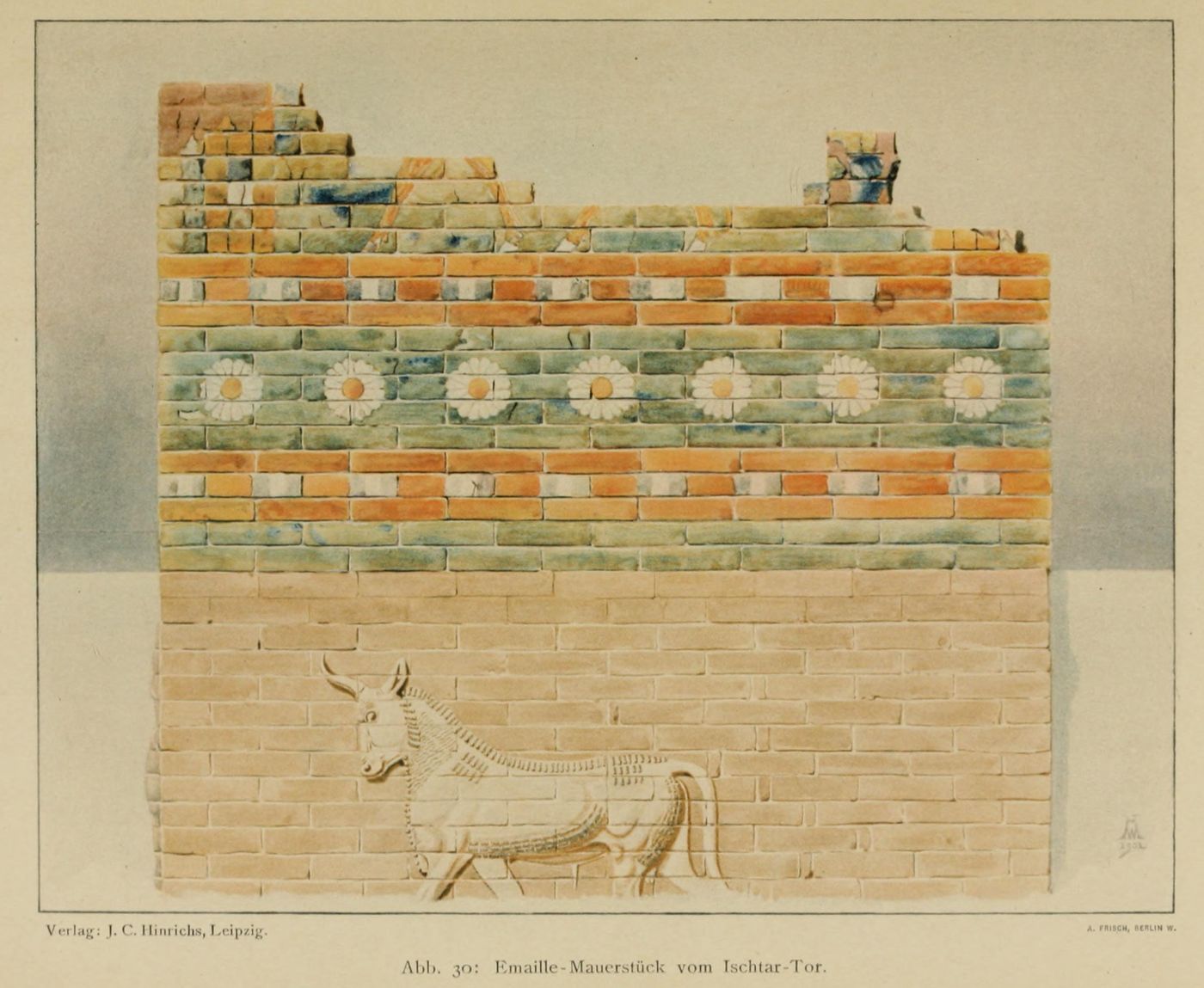
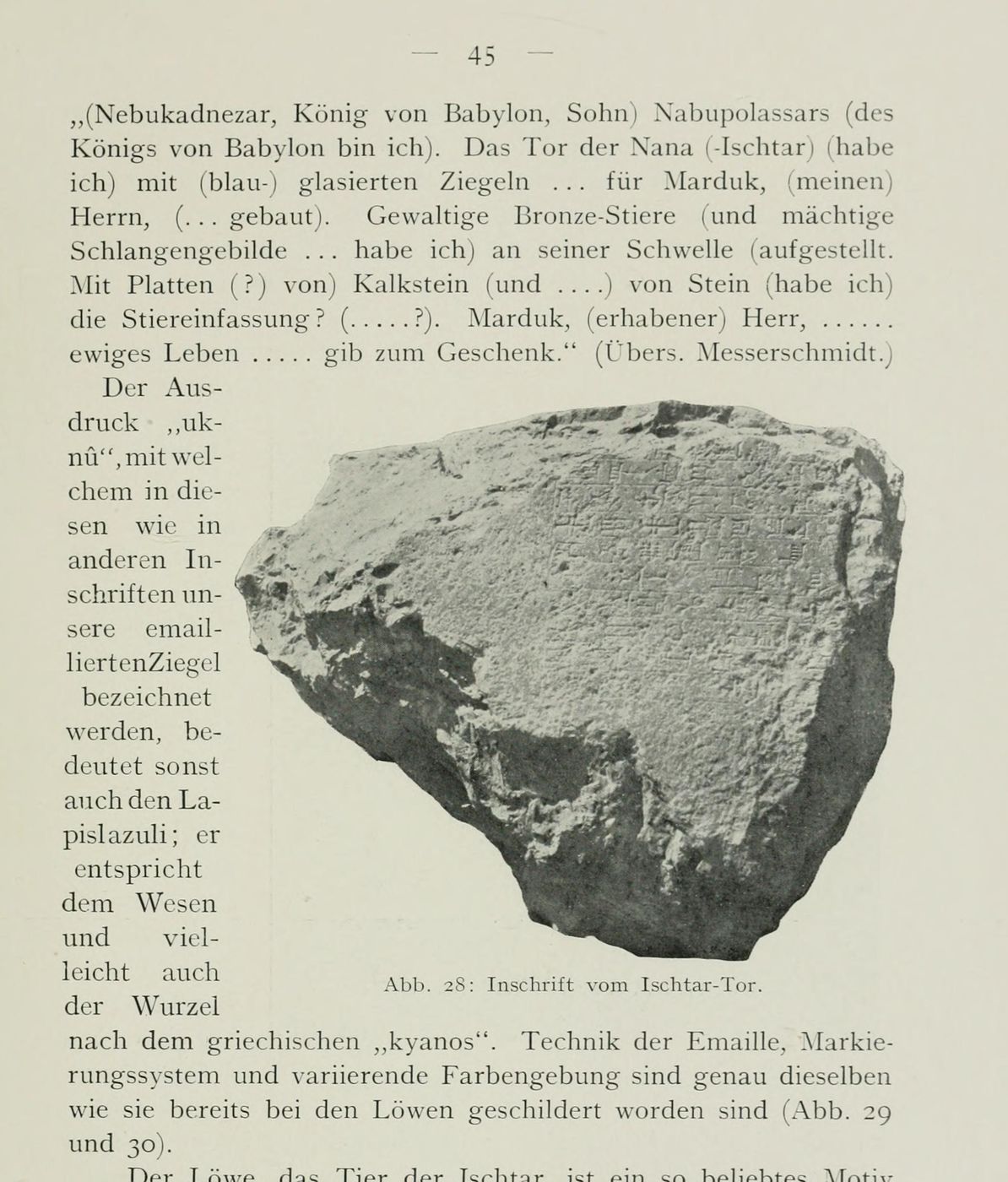
In the sixth century BCE the Ishtar Gate and the Processional Way of Babylon were faced with molded and glazed bricks: lions, bulls and dragons in white and yellow on a blue ground. Robert Koldewey, who excavated Babylon for the Deutsche Orient-Gesellschaft, quoted the king’s own building inscription in Das wieder erstehende Babylon (1913): Nebuchadnezzar built the gate of Ishtar “mit (blau-) glasierten Ziegeln”, with blue-glazed bricks. Koldewey noted that the word in this and other inscriptions for the enameled bricks, uknû, also means lapis lazuli, and corresponds in meaning and perhaps in root to the Greek kyanos. The glazed brick was named after the stone.
Modern analysis has identified the colorants. Aloiz, Douglas and Nagel (2016) summarize the earlier studies: yellow glazes in the ancient Near East have been found, without exception, to contain lead antimonate, which acted both as colorant and opacifier; copper colored the turquoise and green glazes at Khorsabad, Nineveh and Babylon; and calcium antimonate made the white glazes of Babylon, Nimrud and Nineveh. Amadori and colleagues (2023) add that lead antimonate has been reported as the sole yellow opacifier of early Near Eastern vitreous materials, sometimes mixed with red hematite for orange. For the blue, they note that the cobalt-colored glazes of the Ishtar Gate carry nickel, manganese, iron, copper and zinc, the same associated elements as the cobalt sources of Egypt’s Western Oases, and suggest an Egyptian source of the cobalt.
Where the metals came from is less certain. Rodler and colleagues (2019) measured isotope ratios in the glazes of three faunal reliefs from the Ishtar Gate and Processional Way in the Ny Carlsberg Glyptotek, Copenhagen, and tentatively proposed Turkish ore deposits as possible sources of the metal oxide colorants. For the lead, Amadori and colleagues name galena, the lead sulfide, as the most common lead source for glazes in antiquity, and suggest that weathered galena with crusts of secondary lead minerals may have been used. Galena occurs at Franklin and Sterling Hill: Palache (1935) records it in small amounts in the pegmatite of the Trotter mine at Franklin and somewhat more abundantly at Sterling Hill.
Sources and further reading
- Aloiz, E., Douglas, J. G., Nagel, A., 2016, Painted plaster and glazed brick fragments from Achaemenid Pasargadae and Persepolis, Iran. Heritage Science 4, 3. PDF (open access)
- Amadori, M. L., Matin, E., Poldi, G., Mengacci, V., Arduini, J., Callieri, P., Askari Chaverdi, A., Holakooei, P., 2023, Archaeometric research on decorated bricks of Tol-e Ajori monumental gate (6th century BC), Fars, Iran: new insight into the glazes. Journal of Cultural Heritage 60, 63–71. PDF (University of Urbino)
- Koldewey, R., 1913, Das wieder erstehende Babylon. Leipzig: J. C. Hinrichs. P. 45 and Abb. 30. Full scan (Internet Archive)
- Kovalev, I., Rodler, A., Broens, C., Rehren, Th., 2023, Making and working Egyptian blue: a review of the archaeological evidence. Journal of Archaeological Science 153, 105772. Accepted manuscript. PDF (Zenodo)
- Matin, E., 2024, Persepolis West: evidence for a pigment production site and its connections with Achaemenid royal-official buildings. Ancient Civilizations from Scythia to Siberia 29, 262–306. Accepted manuscript. PDF (University of Bologna)
- Oppenheim, A. L., 1973, Towards a history of glass in the ancient Near East. Journal of the American Oriental Society 93, 259–266. JSTOR
- Palache, C., 1935, The minerals of Franklin and Sterling Hill, Sussex County, New Jersey. U.S. Geological Survey Professional Paper 180 (galena). PDF
- Rodler, A. S., Klein, S., Artioli, G., Brøns, C., 2019, Probing the provenance of archaeological glaze colorants: polychrome faunal reliefs of the Ishtar Gate and the Processional Way of Babylon. Archaeometry 61, 837–855. Publisher
- Steinert, U., 2020, Review of S. Thavapalan, The Meaning of Color in Ancient Mesopotamia (Culture and History of the Ancient Near East 104; Leiden: Brill, 2019). Bryn Mawr Classical Review 2020.09.29. BMCR
- Thavapalan, S., Stenger, J., Snow, C., 2016, Color and meaning in ancient Mesopotamia: the case of Egyptian blue. Zeitschrift für Assyriologie 106, 198–214. Publisher
- University of Pennsylvania, 2009, Iraq’s Ancient Past: Rediscovering Ur’s Royal Cemetery. Almanac 56, no. 9. Penn Almanac
- Warburton, D. A., 2014, Ancient color categories. In Encyclopedia of Color Science and Technology. New York: Springer. PDF
- Woolley, C. L., 1929, Ur of the Chaldees: A Record of Seven Years of Excavation. London: Ernest Benn. Pp. 56 and 82. Full text (Internet Archive)
- Yale University, 2014, Digging for color: the search for Egyptian blue in ancient reliefs. YaleNews, 5 May 2014. YaleNews
Written with Claude, an AI model made by Anthropic, from the sources listed above, and checked against them. October 2026.