An astronomer’s count of the distinguishable colors: three simple colors mixed in twelfths, set out in a triangle of ninety-one cells.
The lecture and the edition
Tobias Mayer (1723–1762), born at Marbach in Württemberg, was a largely self-taught mapmaker who in 1751 became professor at the University of Göttingen and from 1754 had sole charge of its new observatory. He is remembered chiefly for his lunar tables, used to find longitude at sea. The Neue Deutsche Biographie suggests that his experience in coloring maps led him to the problem of fixing colors by rule. (The Neue and the older Allgemeine Deutsche Biographie give his death as 20 and 26 February 1762 respectively.)
On 18 November 1758 Mayer read a paper on the relations of colors to a public session of the Royal Society of Sciences at Göttingen. A summary appeared that year in the Göttingische Anzeigen von gelehrten Sachen; the full text was not printed in his lifetime. After his death Georg Christoph Lichtenberg edited his papers, and the essay appeared in 1775 as De affinitate colorum commentatio in the first volume of Mayer’s Opera inedita (Göttingen: Dieterich), its title noting “lecta in conventu publico d. 18. Nov. 1758.”
Three colors in twelfths
Mayer held that there are three simple colors, red, yellow and blue, from which all others are mixed and which cannot themselves be mixed from anything else; white and black he did not count as colors in the proper sense. He wrote each color as a formula of letters, r for red, g for yellow and b for blue, with superscripts giving the proportion of each, so that a color of three parts yellow and two parts blue is g3b2. He was careful to say that these numbers are not algebraic exponents, and called them partientes.
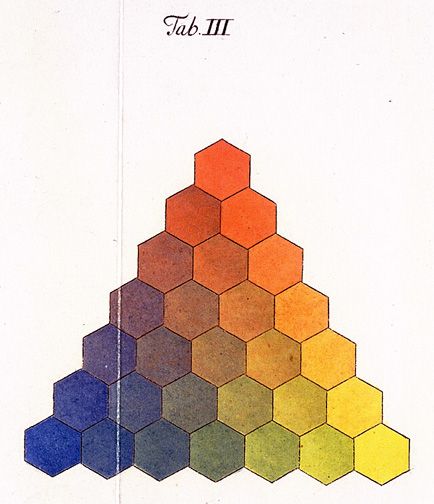
To decide how finely to divide, Mayer reasoned from architecture and music, where ratios above twelve are hardly perceived, and settled on twelve parts: between any two simple colors, eleven intermediate mixtures that the eye can still tell apart. Counting every way of making twelve from one, two or three of the letters gives 3 simple colors, 33 of two and 55 of three, 91 in all. Because 91 is a triangular number with a side of thirteen, the colors can be laid out in a triangle with the simple colors at the corners, the two-color mixtures along the sides and the three-color mixtures within (his Tab. II, an uncolored diagram).
He then added white and black. Each color can be paled with white in twelve steps and darkened in twelve, giving 364 pale colors and 364 dark ones, and 819 distinguishable colors in all. A colored triangle was issued with the 1775 volume; it has seven cells to a side rather than thirteen.
Pigments and the touchstone
Mayer meant the scale for painters. Once a scale of painted cells existed, he wrote, any color offered could be recognized and named, and its proportions of the three simple colors read off, “haud secus ac in lydio lapide auri et argenti species mixtae”: just as alloys of gold and silver are judged on the Lydian stone, the assayer’s touchstone.
His worked example assigns formulas to common pigments: a pigment made from cinnabar is pure red, r12; minium (red lead) is r8g4; ochre is r4g6b2; Berlin blue is r1b11. From these he calculates, by simple equations, what a mixture of three parts minium, four of ochre and two of Berlin blue will give, and what proportions of cinnabar, ochre and Berlin blue will produce a required color. He advised using pigments that contain no acid and can be mixed dry as powders.
Sources and further reading
- Forbes, E. G., 1971, Tobias Mayer’s Opera inedita: the first translation of the Lichtenberg edition of 1775. London: Macmillan.
- Mayer, T., 1775, De affinitate colorum commentatio. In: Tobiae Mayeri Opera inedita, vol. 1, ed. G. C. Lichtenberg. Göttingen: J. C. Dieterich, pp. 31–42 and Tab. II–III. Full scan (Bayerische Staatsbibliothek, MDZ)
- Mayer, Tobias. Neue Deutsche Biographie 16 (1990); Allgemeine Deutsche Biographie 21 (1885). Deutsche Biographie
- Tab. III, the colored triangle of the 1775 edition. Wikimedia Commons
Written with Claude, an AI model made by Anthropic, from the sources listed above, and checked against them. October 2026.