Fifty-six plates of printed color, each a grid of 144 samples, with an index that refers the recorded English color names to a plate, column and row.
A dictionary of names
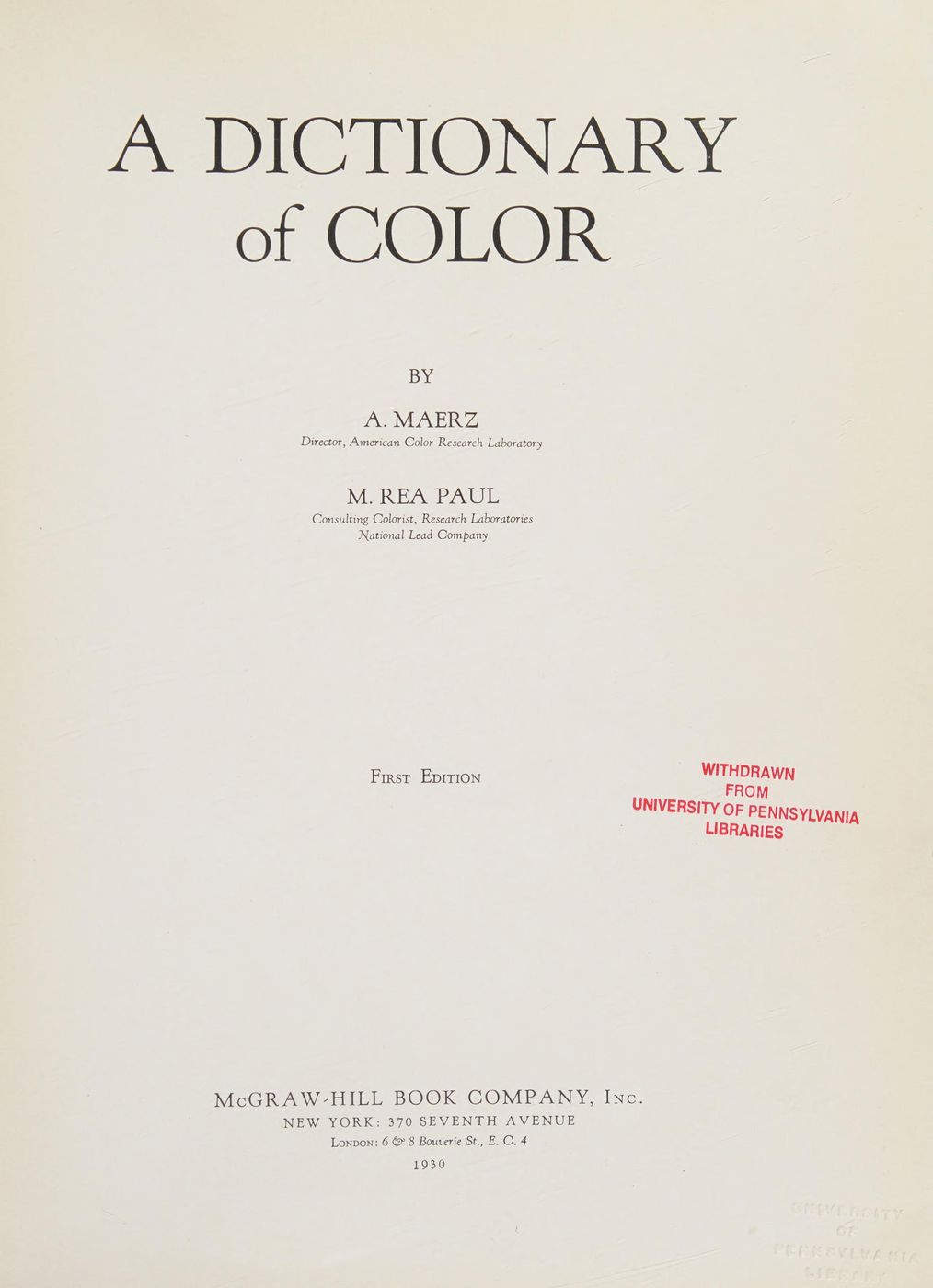
A Dictionary of Color was published by McGraw-Hill in New York in 1930. Its authors were A. Maerz, director of the American Color Research Laboratory, and M. Rea Paul, consulting colorist to the research laboratories of the National Lead Company, which put its color-measuring equipment at their disposal.
The preface states the aim plainly: not a new color system, and no new names, but a record of the names already in print, each fixed to a specific color. The authors gathered named color samples of every kind of material over several years, compared and classified them, and searched old paint-makers’ records for the dates when names first appeared. The book also contains a history of color standardization, a bibliography and notes on individual names.
The plates
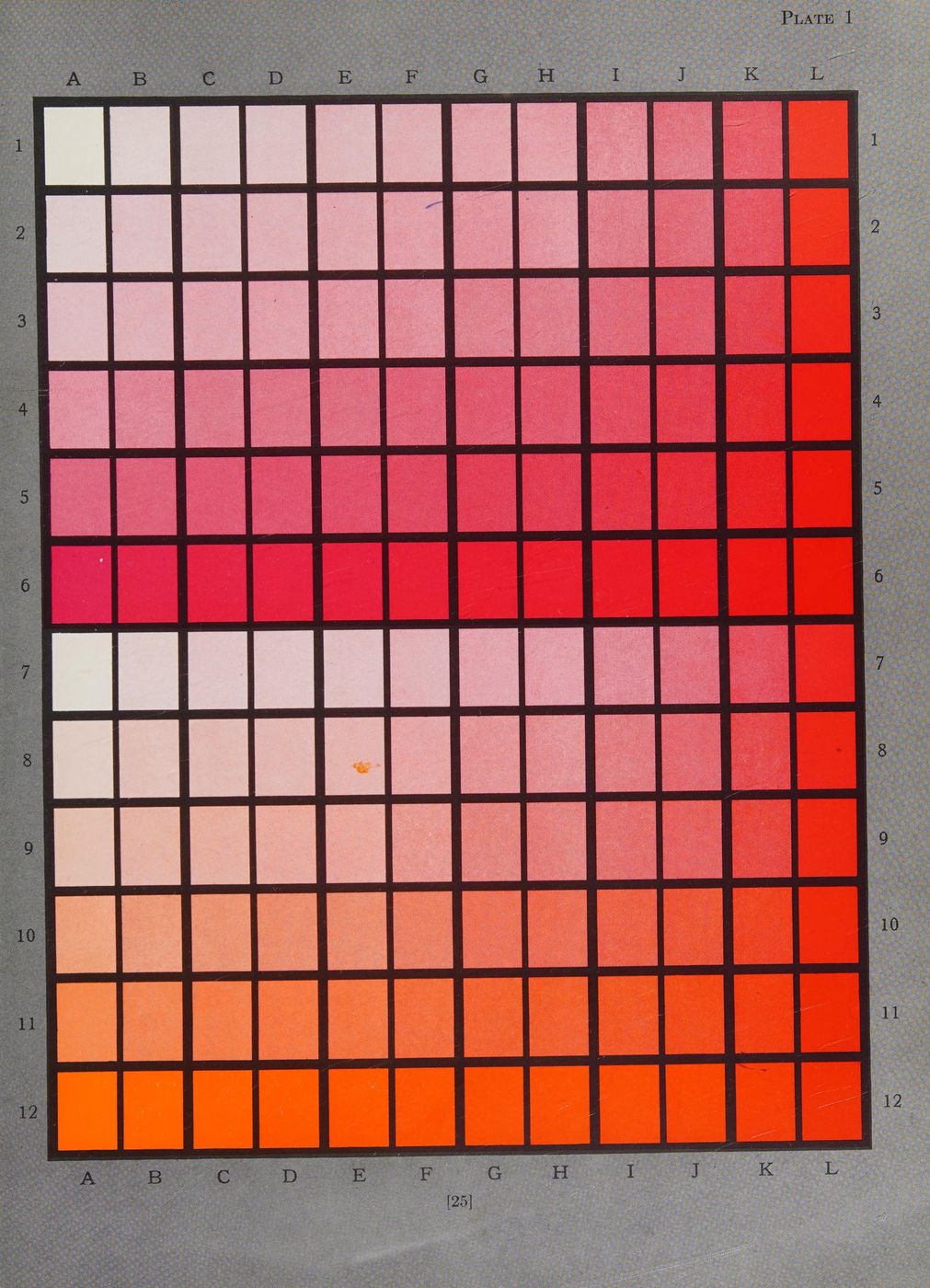
The plan of the work follows the spectrum in seven groups: red to orange, orange to yellow, yellow to green, green to blue-green, blue-green to blue, blue to red, and purple to red. Each group has eight plates. The first shows the colors at full purity grading into white; the next seven repeat them over increasing amounts of gray, toward black, the same seven grays appearing on corresponding plates of every group. Each plate is a grid of twelve columns and twelve rows. The authors chose a scale of twelve steps after printing tests, with smaller intervals among the light colors, and state that the inks were made to be reasonably permanent to light.
Names in current use are printed on an uncolored key grid accompanying each plate; obsolete and rare names appear only in the index, where every name is referred to its color “by the familiar method of plate, column, and row”: citrine, for instance, is 14 L 6.
Names from minerals
Many of the names discussed in the notes are mineral and pigment names, and the authors insist that such names belong to substances. Cinnabar, they write, is the Greek name for the mineral mercuric sulphide, called vermilion when ground; it had been misapplied to a mixture of Prussian blue and chrome yellow sold as “cinnabar green,” and should be applied to nothing but mercuric sulphide. Malachite green is a natural green carbonate of copper found near copper mines and used as a pigment for over three thousand years; the authors place a good average of the mineral at 28 A 9, and regret the later transfer of the name to a coal-tar dye. Their history of color standardization begins with Abraham Gottlob Werner and his suite of mineral colors.
The copyright in the 1930 edition was renewed by the authors in 1957 (renewal R197244). It expired at the end of 2025, and the first edition has been in the public domain in the United States since 1 January 2026. A second edition followed in 1950.
Sources and further reading
- Maerz, A., and Paul, M. R., 1930, A dictionary of color. 1st ed. New York: McGraw-Hill. Full scan (Internet Archive)
- U.S. Copyright Office, Catalog of Copyright Entries, renewals, July–December 1957: A dictionary of color, © 2 June 1930, A23794; renewed 8 August 1957, R197244. Transcription (Project Gutenberg)
Written with Claude, an AI model made by Anthropic, from the sources listed above, and checked against them. October 2026.