Jacob Christoph Le Blon printed pictures from separate red, yellow and blue plates and wrote a short treatise, Coloritto, on composing all colors from those three.
Plates printed one over another

Jacob Christoph Le Blon (1667–1741), a painter and engraver born in Frankfurt am Main, worked out a way to print pictures in color from a set of copper plates, each inked in one color and printed in turn on the same sheet. The plates were worked in mezzotint, a technique that gives continuous tone, so that each plate could lay down its color heavily in some places and lightly in others.
Le Blon moved to London around 1715. George I granted him a royal patent for the process in 1719, and a company was formed to produce his prints; it failed as a business in 1725. In 1734 he left England for Paris, where he received a royal privilege and worked until his death in 1741. The proofs above, from his Paris years, show the method: no single plate gives the picture, but the plates printed in register do.
Coloritto
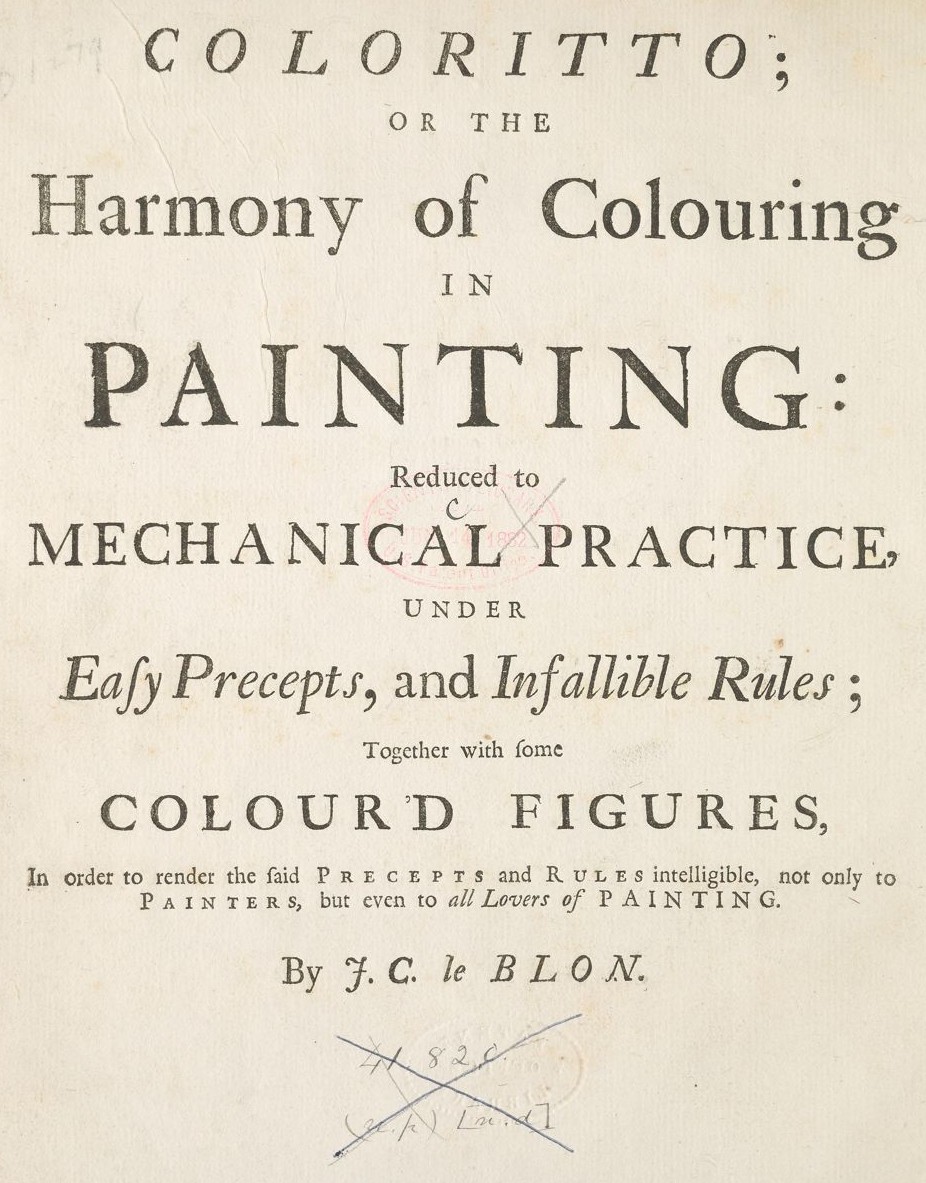
Le Blon set out the principle in a short book in English and French on facing pages, Coloritto; or the Harmony of Colouring in Painting: Reduced to Mechanical Practice, under Easy Precepts, and Infallible Rules. The book carries no date. It is dedicated to Robert Walpole as Chancellor of the Exchequer, and in the dedication Le Blon mentions the letters patent he had been granted and the anatomical tables he was then making under the direction of the king’s anatomist, “Mr. St. André.” Library catalogues date the book variously, from 1720 to 1725; about 1725 is the date most often given.
The first chapter opens with the system itself. “Painting can represent all visible Objects with three Colours, Yellow, Red, and Blue,” Le Blon writes, “for all other Colours can be compos’d of these Three, which I call Primitive.” Yellow and red make orange; red and blue make purple and violet; blue and yellow make green; and a mixture of all three makes black. He adds that he is “only speaking of Material Colours, or those used by Painters”: a mixture of all the “impalpable” colors gives not black but white, “as the Great Sir Isaac Newton has demonstrated in his Opticks.” He thus kept the mixing of pigments apart from the mixing of light.
Pigments for painters
The rest of the book is practical advice to painters, and there Le Blon names actual pigments. For the colors of flesh, he lists vermilion; red earth or burnt yellow ochre; burnt brown ochre; lake; and often umber and burnt umber, each mixed with white. Most of these are mineral pigments: vermilion is mercury sulfide, the color of cinnabar, and the ochres and umbers are iron-bearing earths. Lake is a dye fixed on a mineral base.
More than three plates
Three plates did not always give a deep enough dark or a clean enough light, and Le Blon often used more. Prints from his Paris years were made with a fourth plate; the Copenhagen record of the Fleury portrait gives white as the fourth color. His methods were published after his death by Antoine Gautier de Montdorge in L’art d’imprimer les tableaux (Paris, 1756), which reprints Coloritto and adds a description of how the plates were engraved and printed.
Sources and further reading
- Gautier de Montdorge, A., 1756, L’art d’imprimer les tableaux: traité d’après les écrits, les opérations & les instructions verbales de J. C. Le Blon. Paris: P. G. Le Mercier. Full scan (Internet Archive)
- Jacob Christoph Le Blon. Wikipedia
- Le Blon, J. C., [c. 1725], Coloritto; or the harmony of colouring in painting: reduced to mechanical practice, under easy precepts, and infallible rules. [London.] Full scan (Internet Archive)
- Le Blon, portrait of Cardinal Fleury, 1738: five impressions. Statens Museum for Kunst, public domain, via Wikimedia Commons. Commons
Written with Claude, an AI model made by Anthropic, from the sources listed above, and checked against them. October 2026.