A pyramid of 108 painted colors, mixed by weight from carmine, gamboge and Berlin blue, offered to merchants, buyers, dyers and painters.
The book
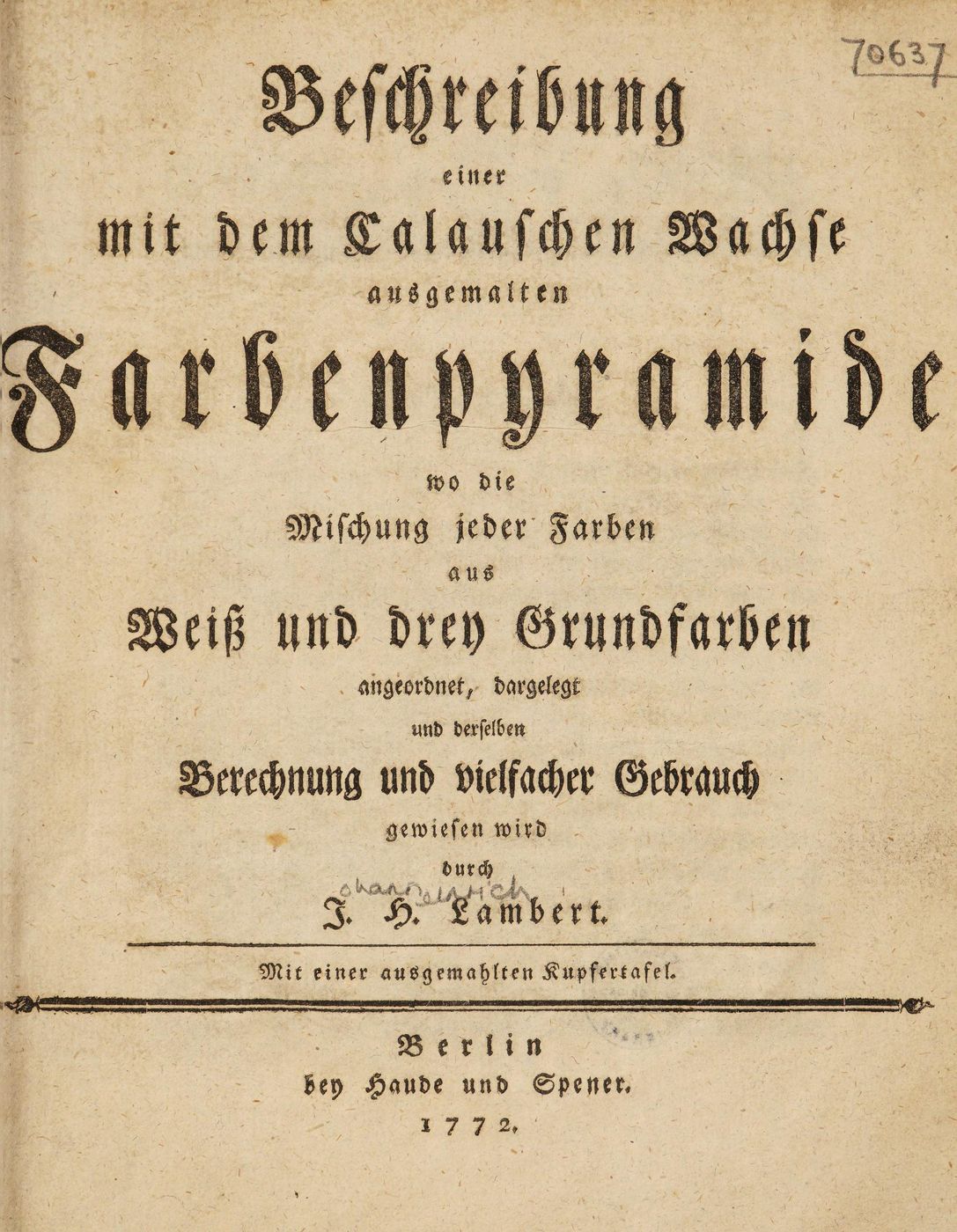
Johann Heinrich Lambert (1728–1777), mathematician, physicist and astronomer of the Berlin Academy, is known in optics for his Photometria of 1760. In 1772 he published a short book with a single hand-colored plate: Beschreibung einer mit dem Calauschen Wachse ausgemalten Farbenpyramide, “Description of a color pyramid painted with Calau’s wax, in which the mixture of every color from white and three primary colors is arranged and set out, and its calculation and many uses shown.”
From Mayer’s triangle
Lambert begins from Tobias Mayer. He reprints the notice of Mayer’s Göttingen lecture of 18 November 1758, which listed common painters’ colors with Mayer’s formulas, orpiment and King’s yellow, yellow ochre, umber, mountain green, minium, English red, ivory black, cinnabar, Florentine lake, Berlin blue and mountain blue among them. Lambert explains that on reading the notice in 1758 he constructed the triangle himself and inferred that Mayer had taken cinnabar, King’s yellow and mountain blue as his red, yellow and blue, a point he had already discussed in the Photometria (§ 1189) and in a memoir of the Berlin Academy for 1768.
The colors for the pyramid were chosen with the Berlin painter Calau, who had rediscovered what he took to be the Punic wax of the ancients. Lambert devotes a chapter to this medium, which bound the mixed colors well and kept them as fresh when dry as when they were laid on. Calau painted trial triangles using carmine, Florentine lake and cinnabar in turn for the red, and varied the yellow and blue as well. The choice fell on carmine, Berlin blue and gamboge.
The pyramid
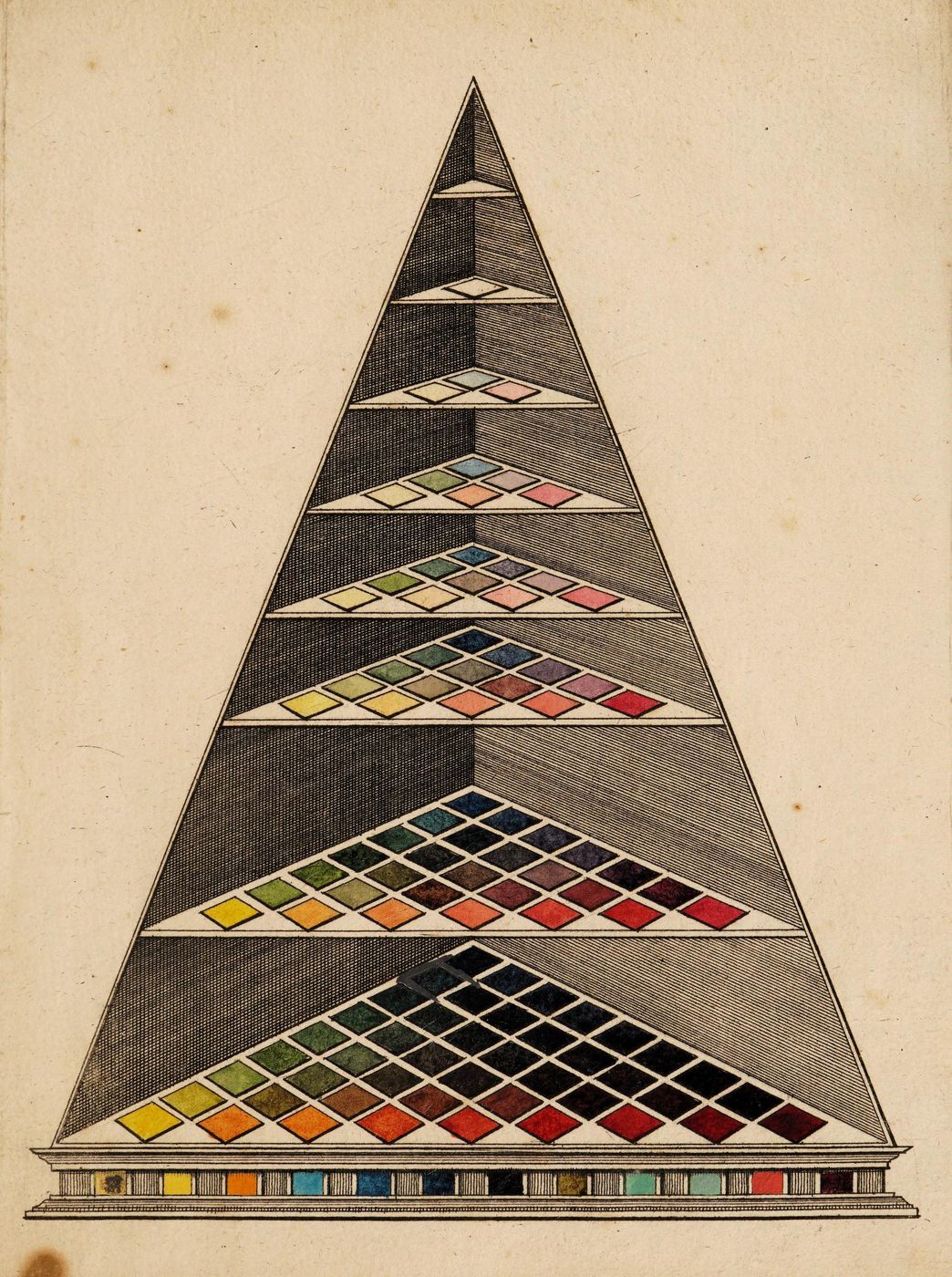
Lambert fixed the strengths of the three colorants by weight, so that each mixture could be made by rule rather than by hours of trial, and arranged the results in a pyramid. The base triangle holds the colors at full strength, with carmine, gamboge and Berlin blue at its corners and their mixtures between; where all three meet, the base darkens toward black. Above it, smaller triangles hold the mixtures in ever greater dilution, rising to white at the apex. The base has 45 fields; with the lighter levels there are 108 in all. The publisher wanted an octavo book and the pyramid would have needed a folio sheet, but a folded sheet would not lie flat with all its colors in the same light; Lambert therefore drew the pyramid in perspective on a single quarto sheet.
The chapter on uses is addressed to ordinary trades. As a pattern card the pyramid lets a merchant check whether his stock of cloth, silk, camel hair and thread covers every color; lets a buyer note the number and triangle of a color and be sure of matching it; helps in embroidering flowers, leaves and fruit; and gives the dyer the proportions of three colorants needed for each mixture. Because the colors are ordered by their relations, Lambert adds, one can remember the place of a color in the pyramid without knowing its name.
Sources and further reading
- Lambert, J. H., 1772, Beschreibung einer mit dem Calauschen Wachse ausgemalten Farbenpyramide. Berlin: Haude und Spener. Full scan (Internet Archive)
- Lambertsche Farbenpyramide. Wikipedia (German)
Written with Claude, an AI model made by Anthropic, from the sources listed above, and checked against them. October 2026.