A pocket book of 720 numbered color samples, made because mycologists could not agree on the names of the colors of mushrooms.
Born of the mushrooms
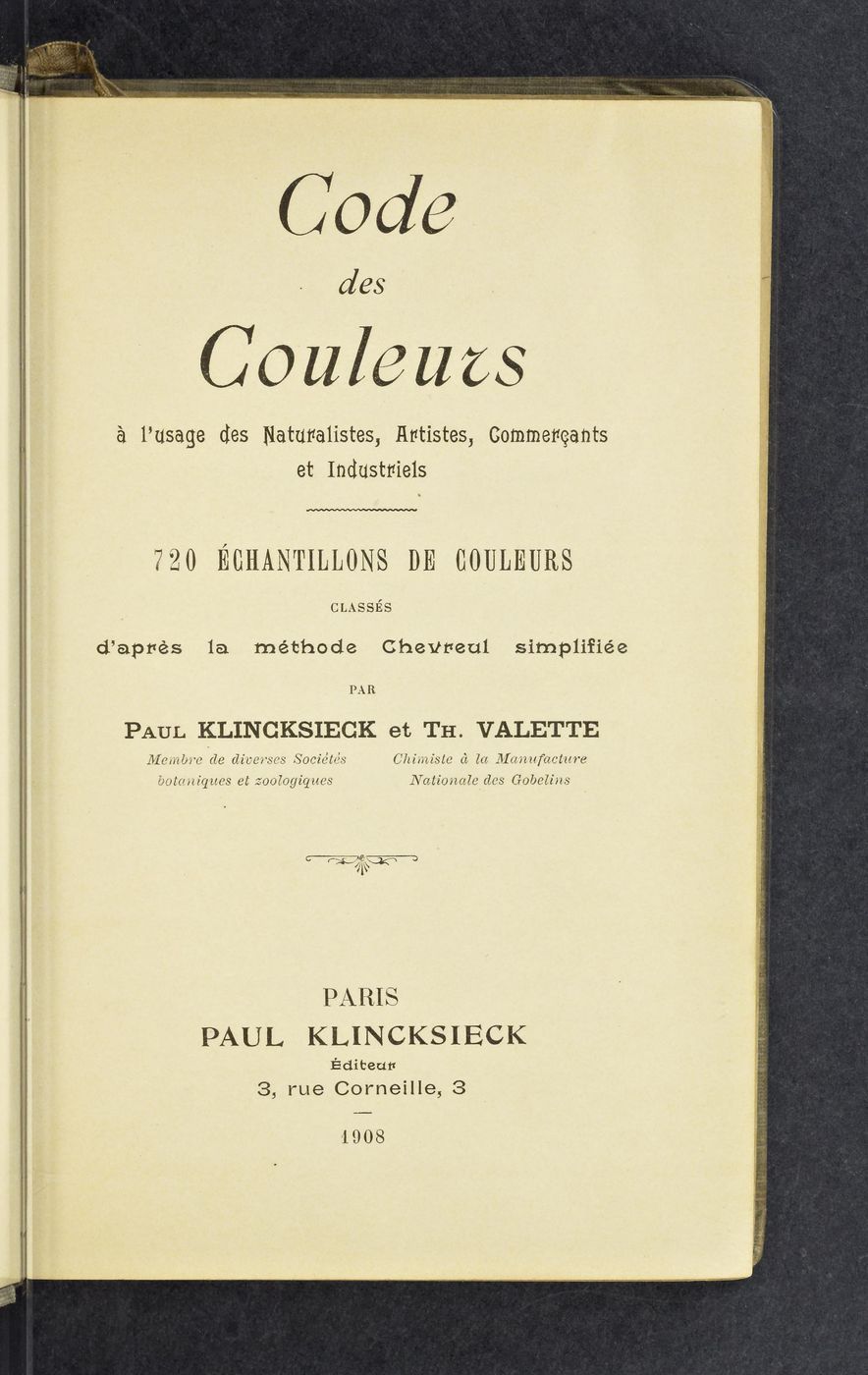
The Code des couleurs à l’usage des naturalistes, artistes, commerçants et industriels was published in Paris in 1908 by Paul Klincksieck, publisher and member of several botanical and zoological societies, and Théodore Valette, chemist at the Manufacture nationale des Gobelins, in the post once held by Michel-Eugène Chevreul. Klincksieck had announced the project in two notes of 1906, in the bulletins of the Société botanique de France and the Société mycologique de France.
“Ce Code doit sa naissance aux Champignons,” Klincksieck writes: the Code owes its birth to the mushrooms. Naturalists keep type specimens so that later workers can compare them, but fleshy fungi cannot be preserved with their color, and color is as necessary as form to tell many species apart. Mycologists had only painted figures and verbal descriptions. The Swedish mycologist Elias Fries, he notes, had used 840 color names, ten of them for white alone, and left no samples to show what he meant, so that mycologists could not make themselves understood to one another.
Numbers instead of names
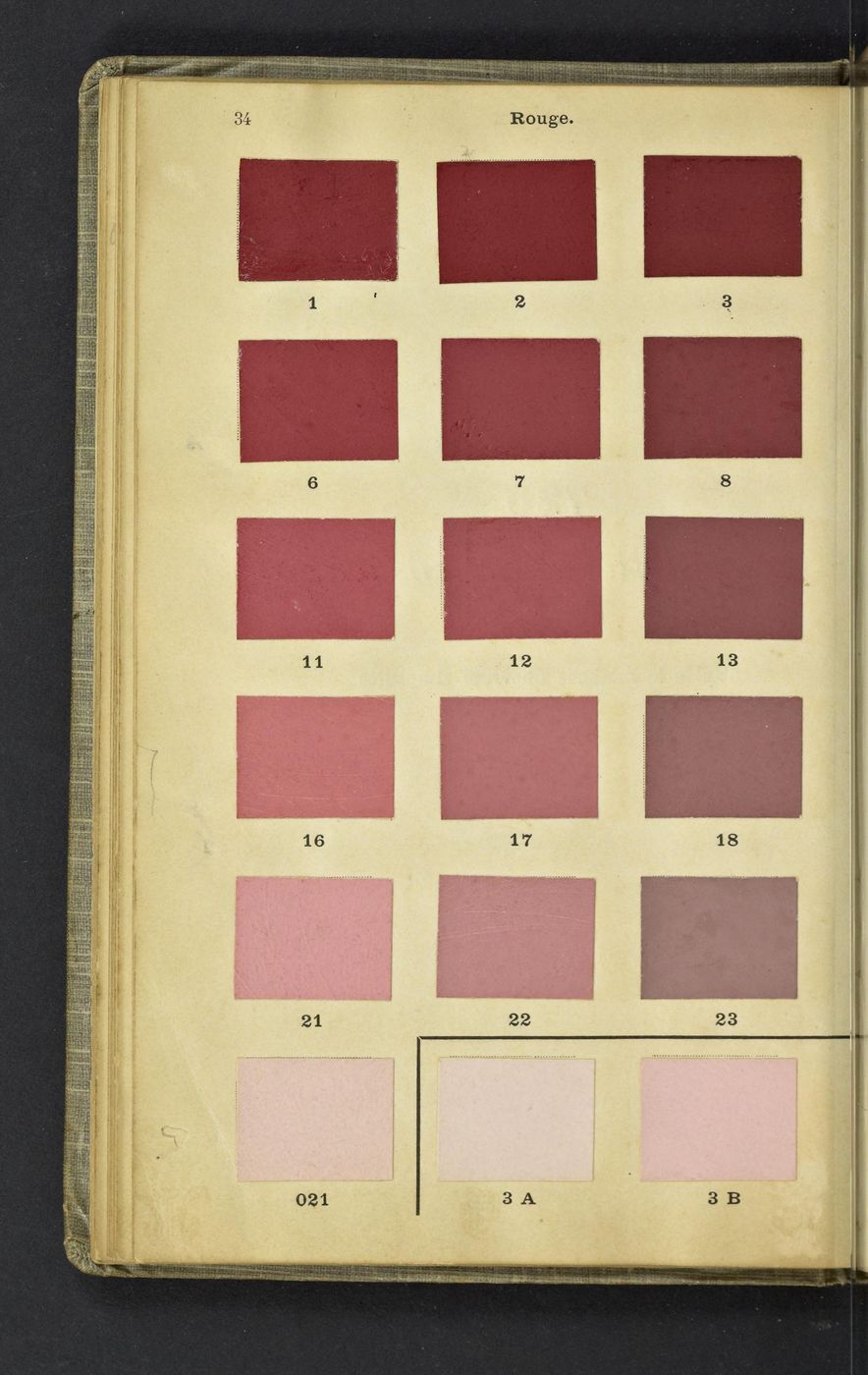
Klincksieck set three requirements: the Code must fit in a pocket; it must not give each tone a name, which would only continue the confusion; and it must be international. Color names were reduced to the six of the spectrum, and each sample was given a number. Valette worked from Chevreul’s chromatic circle, used at the Gobelins for tapestry wools, which divides the circle into 72 hues, grades each in 20 tones and darkens each in ten degrees toward black, 14,421 colors in all. Naturalists, Valette judged, did not need distinctions so fine.
From Chevreul’s 72 hues he took 24 at regular intervals. Each double page carries one hue: a first column of the normal color and four lightened tones, each with half the color of the one above, and four further columns of the same mixtures with increasing small additions of black, up to 75 parts in a thousand. Each hundred of the numbers belongs to one of the six spectrum colors, red, orange, yellow, green, blue and violet in that order, and the final digit gives the column, so that 540 is a blue darkened in the fourth degree and 216 an orange at full strength. Five light tones for each hue, numbered with a leading zero or with the letters A to D, bring the total to 720. Pure grays were left out, since the grays of nature are all tinged with some color.
Every sample was mixed by weight so that it could be reproduced, painted in size colors on coated paper, cut and mounted thirty to a page, and covered with a thin coat of hardened gelatine. Valette chose fast colorants and left out some brilliant light pinks because the coal-tar dyes that gave them faded. A small mask (the mirette) on a ribbon isolates a single sample, and an appendix gives the names of the ten principal colors in eighteen European languages.
Sources and further reading
- Klincksieck, P., and Valette, T., 1908, Code des couleurs à l’usage des naturalistes, artistes, commerçants et industriels. 720 échantillons de couleurs classés d’après la méthode Chevreul simplifiée. Paris: Paul Klincksieck. Full scan (Internet Archive)
Written with Claude, an AI model made by Anthropic, from the sources listed above, and checked against them. October 2026.