Color as a mark of rank at the Asuka court, the named color combinations of court dress, and the color systems of modern Japan.
Color and rank
In 603 the Japanese court adopted the Twelve Level Cap and Rank System (kan’i jūnikai), adapted from systems already in use in Sui China and the Korean kingdoms of Paekche and Goguryeo. Both are described in the Chinese Book of Sui (636), chapter 81: Paekche distinguished its sixteen ranks by the color of the belt, purple for the highest, then black, red, blue, yellow and white; in Goguryeo the nobles wore caps of purple gauze ornamented with gold and silver. The same chapter lists the twelve Japanese ranks, beginning with greater and lesser virtue. The Japanese chronicle Nihongi (720) records the institution of the caps in the twelfth month of 603, each “made of sarcenet of a special colour” (Aston’s translation, 1896, vol. 2, p. 128). Officials held one of twelve ranks, the greater and lesser grades of six Confucian virtues, and each rank was shown by the color of the official’s silk cap. Purple, in deep and light shades, marked the highest ranks. The colors of the lower ranks are not recorded with certainty and vary between sources. The system was replaced in 647.
Color remained a matter of rank at court. Some colors were forbidden (kinjiki) except to those of high rank; others were permitted to all (yurushiiro).
The layered colors of court dress
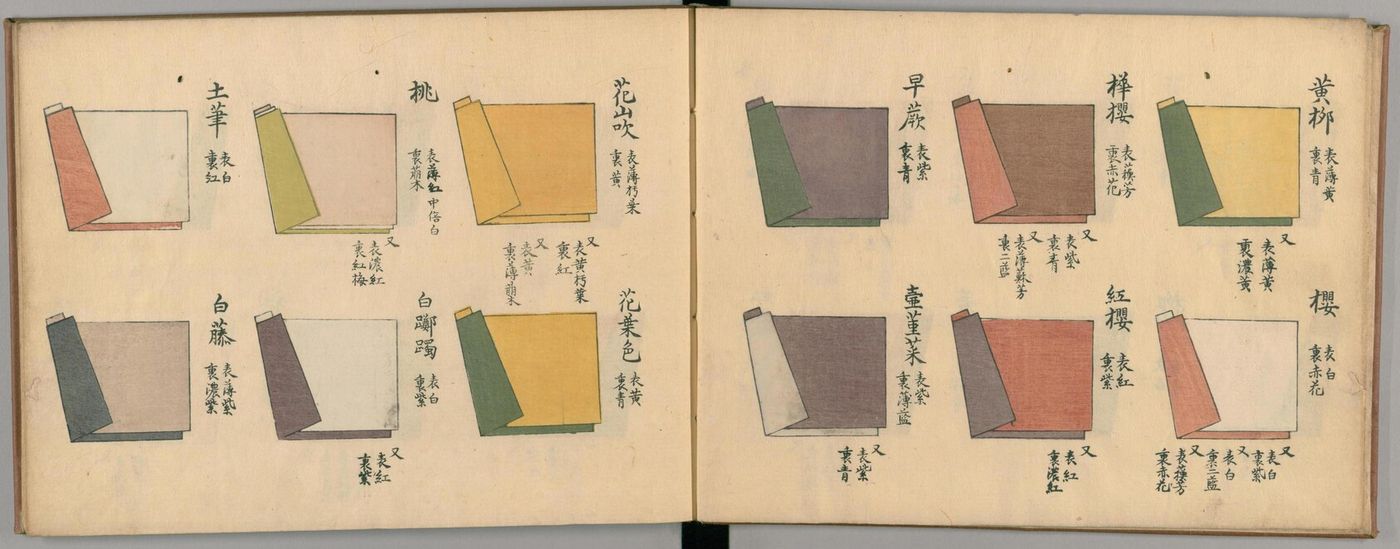
Court robes were worn in layers, and the combination of colors at the face and the lining of a garment had a name, often that of a plant in its season. Printed books recorded these combinations. The book above gives each a pair of swatches, face over lining, with its name and, beside it, the colors of the face (表) and the lining (裏).
Modern standards
In 1964 the Japan Color Research Institute published the Practical Color Co-ordinate System (PCCS). It describes a color by two attributes, hue and tone, where tone combines lightness and saturation. There are twenty-four hues and twelve tones, with five grays, written as short codes such as 4:rO for a reddish orange. The Japanese Industrial Standard JIS Z 8102 sets out names for the colors of objects, both systematic names and traditional ones.
Sources and further reading
- Aston, W. G., trans., 1896, Nihongi: Chronicles of Japan from the earliest times to A.D. 697, vol. 2, p. 127–128 (the cap-ranks of 603). Internet Archive
- Kasane irome (重色目), signed 猪飼正彀, 1817. National Diet Library, call no. 847-34. Full scan (Commons)
- Practical Color Coordinate System. Wikipedia
- Twelve Level Cap and Rank System. Wikipedia
- Wei Zheng and others, Sui shu (Book of Sui), 636, chapter 81 (Dongyi: Goguryeo, Paekche, Wa). Chinese text. Wikisource
Written with Claude, an AI model made by Anthropic, from the sources listed above, and checked against them. October 2026.