The Cairo treatise on light and vision in which colors are real properties of bodies, radiated with light from every point and never seen without it.
The Kitāb al-Manāẓir
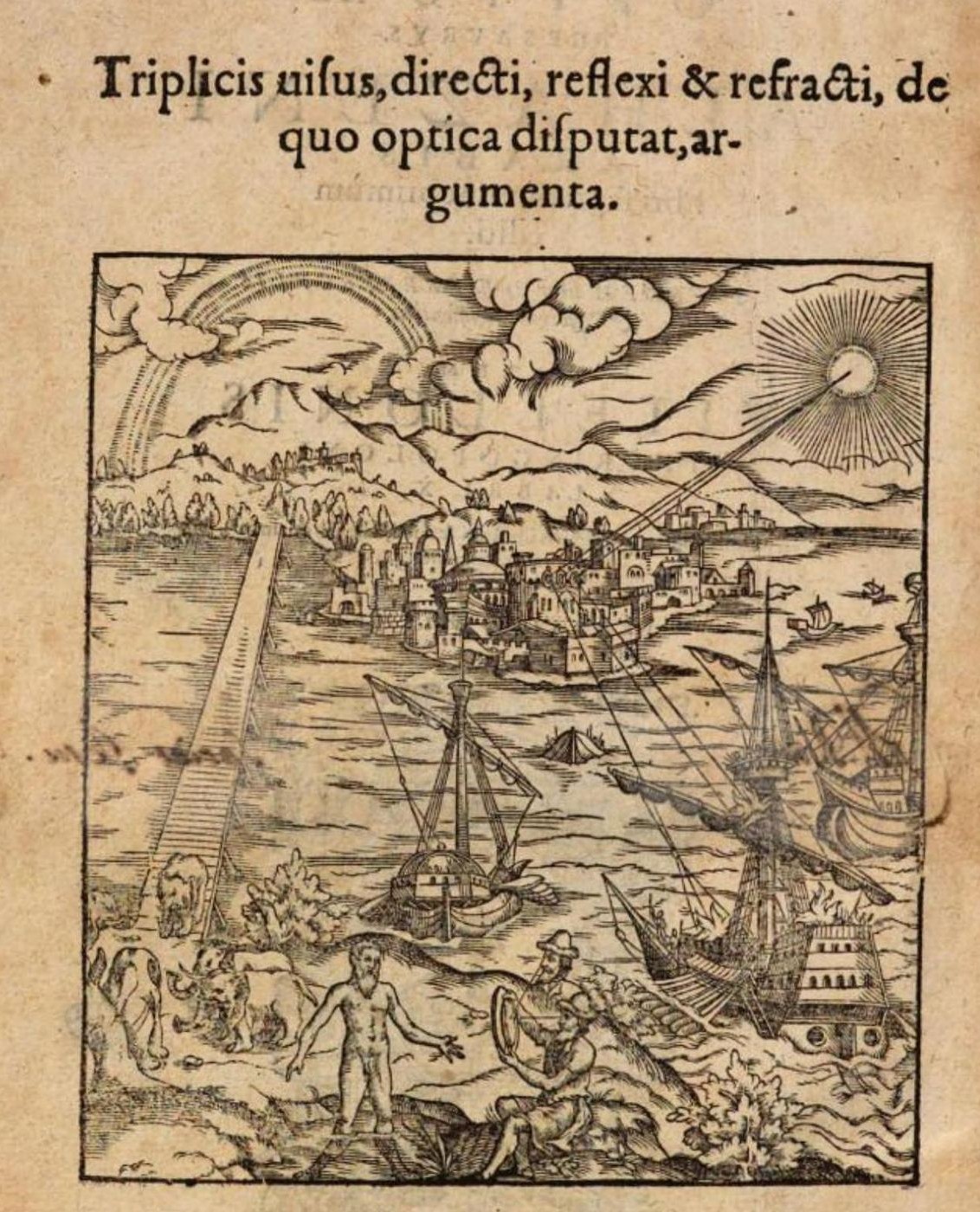
Abū ʿAlī al-Ḥasan ibn al-Ḥasan ibn al-Haytham (born 965, died in Cairo about 1040), known in Latin as Alhazen, came from Iraq to Fāṭimid Egypt in the reign of the caliph al-Ḥākim and spent the rest of his life in Cairo. His Kitāb al-Manāẓir (Book of Optics), in seven books, deals with light, the eye, vision, reflection and refraction. Its date is not certain. It appears in a catalogue of his works that runs to 1038, and it is often placed in the years before al-Ḥākim’s death in 1021; the year used here is that conventional date, not an established one.
The account below follows A. I. Sabra’s article in the Dictionary of Scientific Biography (1972). Sabra’s English translation of books I–III (London: Warburg Institute, 1989) is the standard edition of those books.
Light and color
In book I, chapter 3, Ibn al-Haytham sets out the properties of light and supports them with experiments using sighting tubes, strings and darkened rooms. Self-luminous bodies, and bodies lit by them, radiate light from every point, in straight lines and in all directions.
Colors are treated in the same way. As Sabra summarizes the chapter, colors are held to be as real as light and distinct from it; they exist as forms of colored objects and, like light, radiate from every point of a colored surface in all directions. Ibn al-Haytham allowed that colors might be able to extend into the air without light, but found by experiment that they are always found together with light, mingled with it, and are never visible without it. Whatever rules apply to light apply to colors.
Vision follows from this. Every point of a visible object sends the forms of its light and color in straight lines to the eye, and Ibn al-Haytham explains how, of all the rays from a point, only the one that meets the eye perpendicularly gives a clear and orderly image. The book contains no ordered scale or naming of colors. Its importance for color lies in making color a physical property carried by light, to be studied by experiment and geometry.
The Latin Alhazen
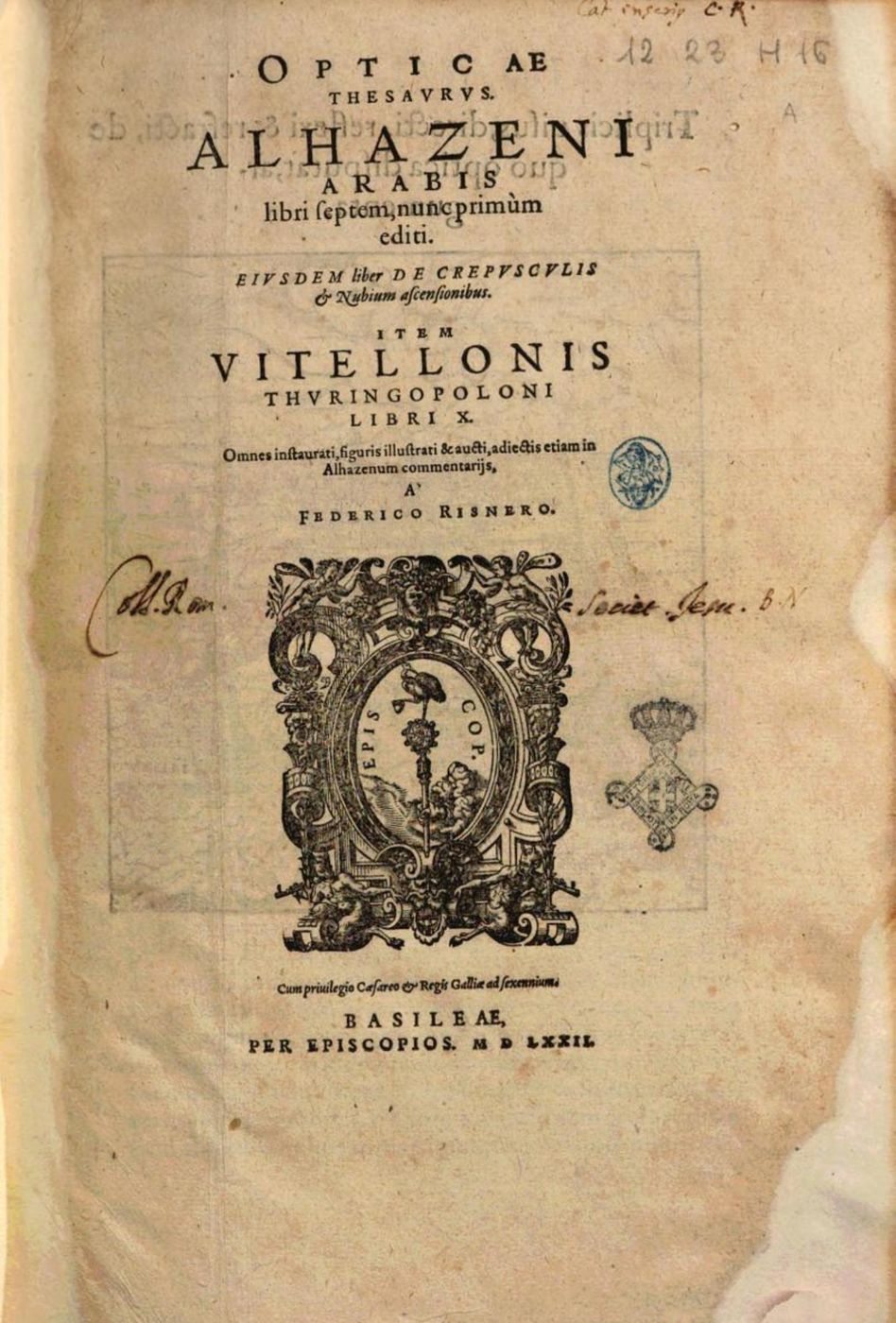
The Optics was translated into Latin in the late twelfth or early thirteenth century, under the title De aspectibus or Perspectiva; the translator is unknown. Friedrich Risner printed it at Basel in 1572 as Opticae thesaurus, together with the optics of Witelo. According to Sabra, the Latin text lacks the first three chapters of book I, so the chapter on light and color summarized above did not reach Latin readers in that form. Through the Latin translation the book was read by Roger Bacon, John Pecham and Witelo, and through Risner’s edition by Kepler and his successors.
Sources and further reading
- Risner, F., ed., 1572, Opticae thesaurus. Alhazeni Arabis libri septem, nunc primum editi. Basel: Episcopius. Full scan (Internet Archive)
- Sabra, A. I., 1972, Ibn al-Haytham. Dictionary of Scientific Biography, vol. 6, pp. 189–210. New York: Charles Scribner’s Sons. DSB article (PDF)
- Sabra, A. I., trans., 1989, The Optics of Ibn al-Haytham, Books I–III: On Direct Vision. 2 vols. London: Warburg Institute. In copyright; cited, not quoted.
Written with Claude, an AI model made by Anthropic, from the sources listed above, and checked against them. October 2026.