The mineral palette of Egyptian painting, the first synthetic pigment, the Egyptian words for color, and a blue that glows in the infrared.
The first synthetic pigment
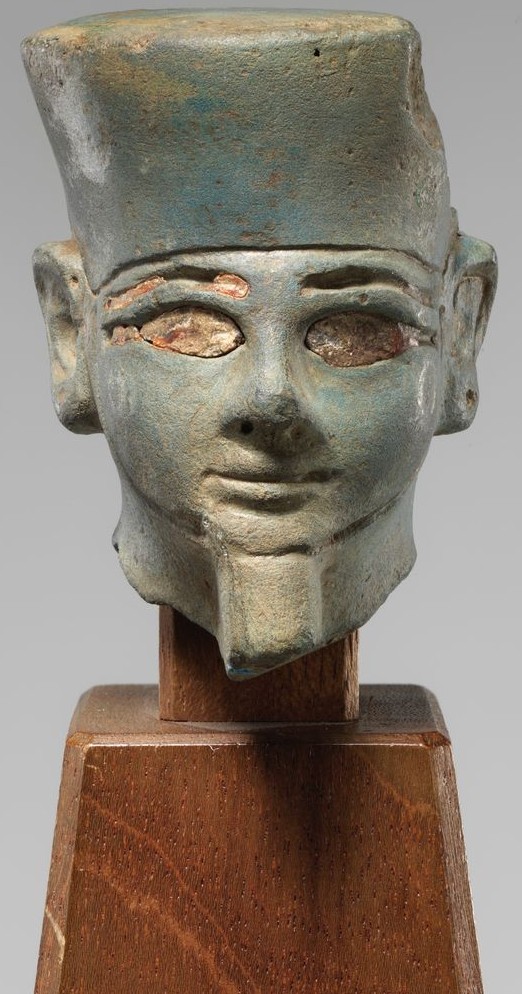
Egyptian blue is the oldest human-made inorganic pigment. A review of the archaeological evidence by Kovalev, Rodler, Broens and Rehren (2023) places its appearance in Egypt at about 3100 BCE, at the opening of the dynastic period, citing Richard Newman (2014), and notes that it may be earlier still: Lorelei Corcoran (2016) has argued for its use in the Predynastic period. The dates are those of the objects that carry the pigment, fixed by their archaeological context; the pigment itself cannot be dated directly.
It was made, not mined. Finely ground quartz, a calcium carbonate, and a copper compound were fired together with a little alkali flux at roughly 850 to 1050 °C. The blue crystals that form are calcium copper silicate, CaCuSi4O10, compositionally and structurally equivalent to the very rare mineral cuprorivaite; the rest of the product is unreacted quartz and glass. The raw materials themselves were often minerals: Kovalev and colleagues list quartz pebbles or clean sand for the silica, limestone, shell or lime-rich sand for the calcium, natron or plant ash for the alkali, and for the copper either the metal, its alloys, or the ores malachite and azurite. Egyptian blue remained the standard blue of Egyptian art, and production in Egypt continued until at least the third century CE.
Cuprorivaite as a natural mineral was described by C. Minguzzi in 1938 from Vesuvius, where it occurs intimately mixed with quartz. The Handbook of Mineralogy gives it as tetragonal, azure in color, vitreous in luster, with a hardness of about 5, and lists only a handful of localities, among them Vesuvius, the Sattelberg cone in the Eifel, Wheal Edward in Cornwall and Summit Rock in Oregon. The Egyptian workshops were manufacturing in quantity a compound that nature makes only rarely.
The mineral palette
Apart from Egyptian blue and its green counterpart, the colors of Egyptian painting were ground minerals. The survey of pigments in Hedegaard, Delbey, Brøns and Rasmussen (2019), written for their study of the painted reliefs of the palace of Apries (Dynasty 26), summarizes what analysis has found, color by color.
White. Calcite (calcium carbonate), gypsum and anhydrite (calcium sulfates) were the most common whites from the Predynastic to the Roman period, used both for the ground layer and for white paint. Huntite, the magnesium calcium carbonate Mg3Ca(CO3)4, is attested from the Old Kingdom on; it gives a brighter white than calcite and appears to have been the predominant white of the New Kingdom.
Red and yellow. Red ochre, colored by the iron oxide hematite, was the dominant red. Most yellows are yellow ochres colored by goethite, the iron oxide hydroxide. Orpiment, the yellow arsenic sulfide, is found from at least the Twelfth Dynasty on, sometimes in place of gold; the orange-red arsenic sulfide realgar appears in a few instances of the Eighteenth and Nineteenth Dynasties. The lemon-yellow iron sulfates jarosite and natrojarosite are attested from the Old Kingdom to the Ptolemaic period.
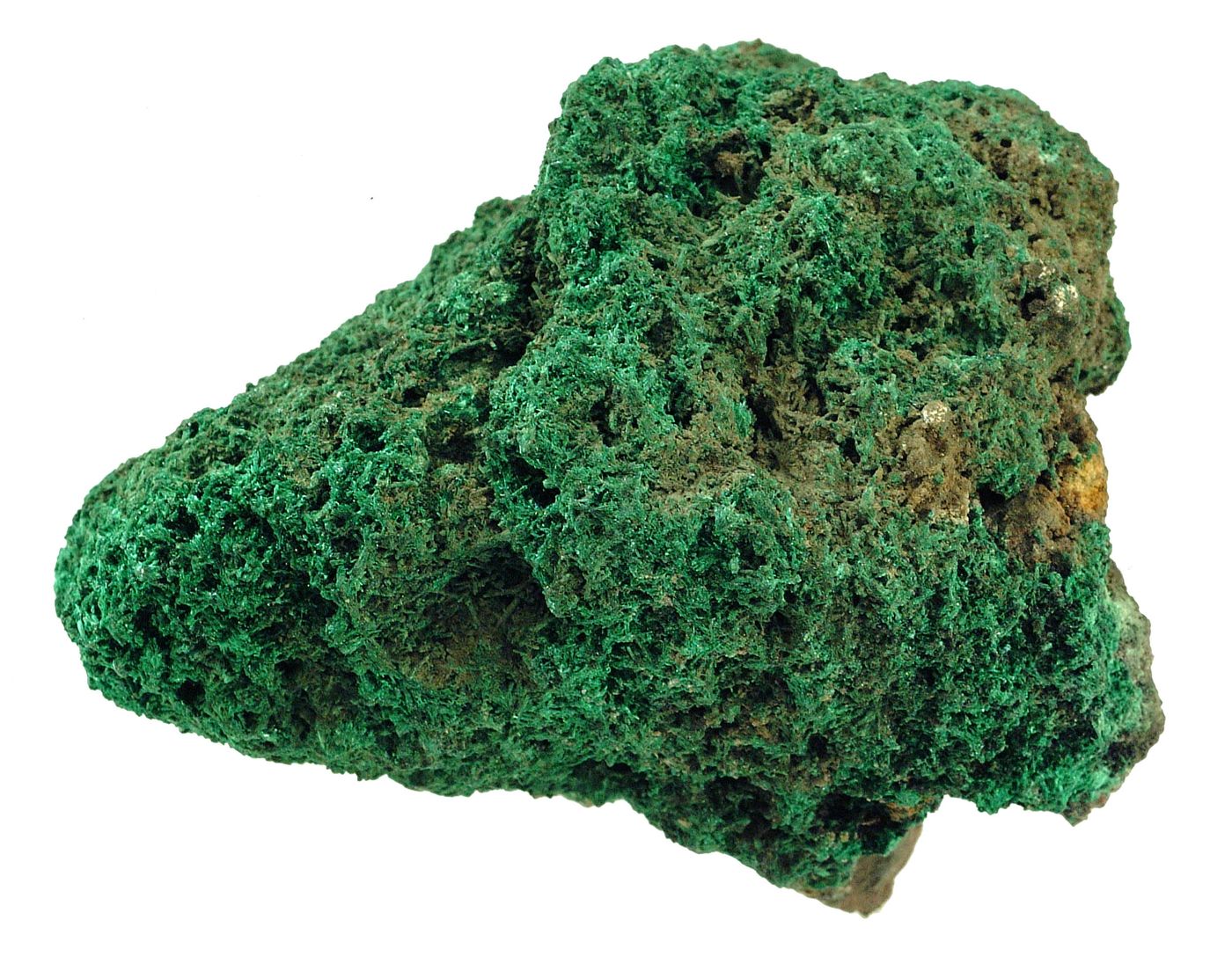
Green. For green the Egyptians generally used a synthetic, Egyptian green, made from the same ingredients as the blue in different proportions and fired hotter; the earliest known example is nearly a millennium younger than the earliest Egyptian blue. The copper minerals malachite and chrysocolla have also been identified as green pigments in a few cases.
Blue. Other blues are almost absent. Azurite, the blue copper carbonate, has been confirmed only once, on a fragment of painted leather of the early Eighteenth Dynasty from Thebes. A cobalt blue was used on pottery of the Amarna period alone.
Black. The predominant blacks were carbon, made by charring plant material or by collecting soot. A manganese black was used more rarely.
Green and black for the eyes
Before there were painted tombs, minerals were ground for the body. In the UCLA Encyclopedia of Egyptology, Alice Stevenson (2009) writes that the vivid green mineral malachite was the substance most often ground on the stone palettes of the Predynastic period, as far as burials show. Green eye paint is attested in Early Dynastic times, and traces of malachite have been observed on the faces of several bodies at the Predynastic cemetery of Adaima. Galena, the lead sulfide, and hematite and red ochre were also processed on the palettes, probably mixed with resins, oils or fats.
Flat palettes went out of use during the First Dynasty, but the cosmetics did not: malachite and kohl continue to appear in tomb offering lists through pharaonic history. The Egyptian word for the green mineral eye paint, wꜣḏw, is built on the word for green.
A blue that glows
Egyptian blue has a property that sets it apart among pigments. Under visible light it emits invisible near-infrared light. Accorsi, Verri and colleagues (2009) described this luminescence of cuprorivaite, and in the same year Giovanni Verri (2009) showed how to use it: lit with visible light and photographed with a camera that records only the infrared, Egyptian blue shines bright against a dark ground. The method, visible-induced luminescence (VIL) imaging, reveals particles of the pigment too small or too faded to see.
As Hedegaard and her colleagues describe it, the pigment absorbs visible light and re-emits it in the range 800–1000 nm, with a peak near 910 nm. The method is now standard in conservation. Kovalev and colleagues recommend it for finding pigment residues on the tools of ancient workshops, and in 2023 it was used on the Parthenon sculptures in the British Museum, as King’s College London reported, to find microscopic traces of Egyptian blue.
The Franklin and Sterling Hill minerals for which this site exists fluoresce in visible colors under ultraviolet light. Egyptian blue glows by a different path: visible light in, infrared out. Its glow belongs to the crystal it shares with the mineral cuprorivaite.
The color words
Egyptian had four basic color terms, and they were verbs. As David Warburton summarizes the work of Wolfgang Schenkel, they are ḥḏ “to be white,” km “to be black,” dšr “to be red” and wꜣḏ “to be green.” Other colors were named after materials: ḫsbḏ, lapis lazuli, served for dark blue, and mfkꜣt, turquoise, for light blue. These were nouns and similes, not verbs.
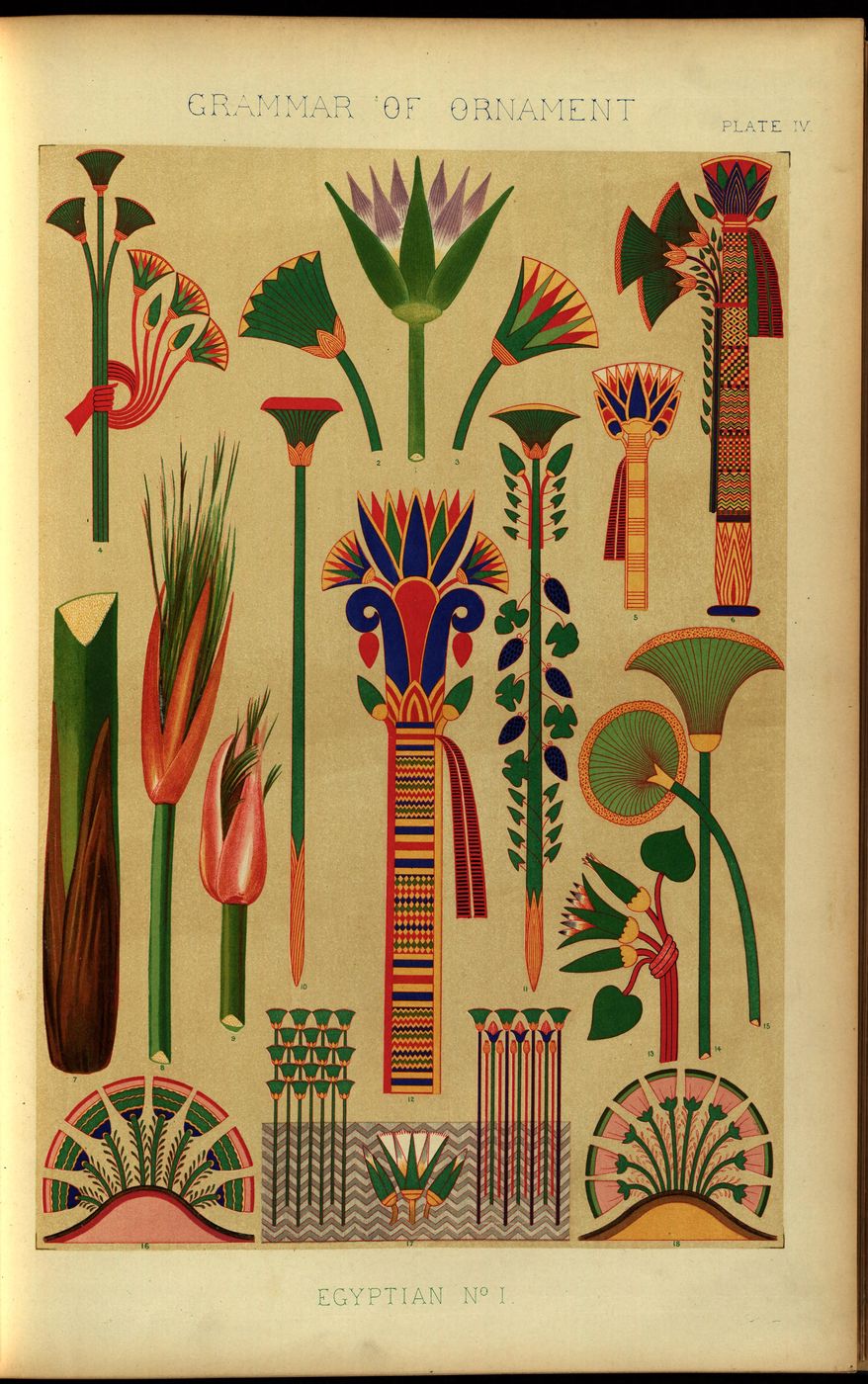
The words are tied to things. ḥḏ is also the word for silver. wꜣḏ is also the noun for the papyrus stem, the emblem of Lower Egypt, and the verb means to be fresh and to flourish as well as to be green. Its derivative wꜣḏw names the green mineral pigment used as eye paint. Some modern accounts give wꜣḏ a range from green to blue-green; Warburton places its focus in green, neither blue-green nor yellow-green.
Lapis lazuli had to be imported: the only known deposits in the Old World are in Afghanistan. Warburton notes that only gold and lapis lazuli were priced above silver. Its name, ḫsbḏ, became the word for its color, as the Akkadian word for lapis, uqnu, did in Mesopotamia; Warburton traces the Greek kyaneos, blue, to the Akkadian.
Black land, red land
Two of the color words named the country itself. Kmt, “the Black Land,” was a name for Egypt, the dark alluvial soil of the Nile valley; dšrt, “the Red Land,” was the desert around it. A statue of Amenhotep III calls the king “king of the Black Land, ruler of the Red Land.”
In Andrzej Ćwiek’s study of red and black (2014), drawing on Gay Robins, black was the color of fertile soil and so carried connotations of fertility and regeneration; red was the color of blood, fire, the sun and the desert, potent and dangerous but also protective. Ćwiek stresses, after Robins, that the meaning of a color was not fixed but set by its context. Red, black and white formed the earliest palette; following John Baines, yellow, green, blue and grey were added from the Old Kingdom on.
Vitruvius on the Alexandrian blue
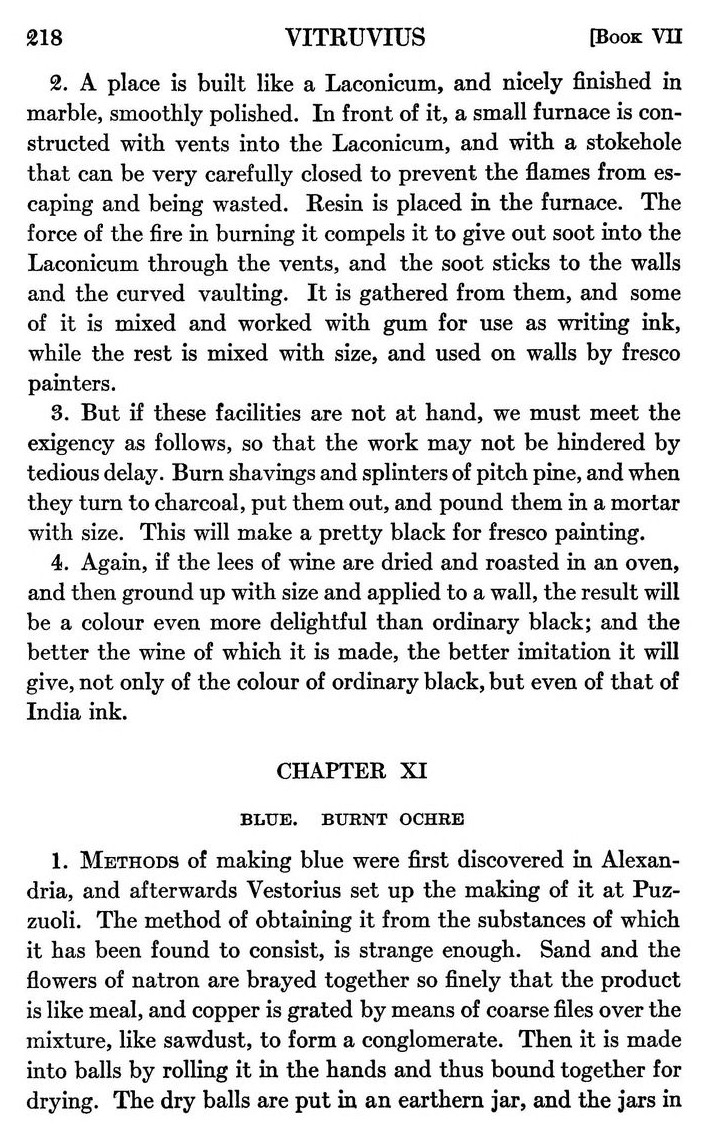
The only ancient account of how the pigment was made is Roman. In De architectura, written in the first century BCE, Vitruvius begins Book VII, Chapter XI: “Caerulei temperationes Alexandriae primum sunt inventae.” In Morgan’s translation of 1914:
Methods of making blue were first discovered in Alexandria, and afterwards Vestorius set up the making of it at Puzzuoli. The method of obtaining it from the substances of which it has been found to consist, is strange enough. Sand and the flowers of natron are brayed together so finely that the product is like meal, and copper is grated by means of coarse files over the mixture, like sawdust, to form a conglomerate. Then it is made into balls by rolling it in the hands and thus bound together for drying. The dry balls are put in an earthern jar, and the jars in an oven.
In the heat, he goes on, the copper and the sand “mutually receive each other’s sweat” until they are “reduced to a blue colour.” He names sand, natron and copper but no lime; the calcium may have come with a lime-rich sand. His “first discovered in Alexandria” cannot be taken literally, since the city was founded in 331 BCE, more than two and a half thousand years after the earliest Egyptian blue; it records where the pigment was made in the Hellenistic world. The hand-rolled balls match the evidence: Kovalev and colleagues report pellets of 1 to 4 cm from Hellenistic and Roman workshops, where earlier producers had made the pigment in cakes and blocks.
Sources and further reading
- Accorsi, G., Verri, G., Bolognesi, M., Armaroli, N., Clementi, C., Miliani, C., Romani, A., 2009, The exceptional near-infrared luminescence properties of cuprorivaite (Egyptian blue). Chemical Communications, 3392–3394. Publisher
- Cavaleri, T., et al., 2024, Discovering manganese-based blacks in the grave goods of Kha and Merit (Egypt, 1450–1400 BCE). Dyes and Pigments 231, 112400. PDF
- Ćwiek, A., 2014, Red and black world. Studies in Ancient Art and Civilization 18. PDF
- Egyptian words wꜣḏ, wꜣḏw, ḥḏ, ḫsbḏ and kmt, with references to the Wörterbuch der ägyptischen Sprache and Faulkner’s Concise Dictionary of Middle Egyptian. Wiktionary
- Handbook of Mineralogy: Cuprorivaite. Mineral Data Publishing, 2001. PDF
- Head of Amun with inlaid eyes, Egyptian blue, Dynasty 22–23. The Metropolitan Museum of Art, 2021.41.93. Open Access, CC0. The Met
- Hedegaard, S. B., Delbey, T., Brøns, C., Rasmussen, K. L., 2019, Painting the Palace of Apries II: ancient pigments of the reliefs from the Palace of Apries, Lower Egypt. Heritage Science 7, 54. Open access
- Jones, O., 1856, The Grammar of Ornament. London: Day and Son. Plate IV, Egyptian No. 1. Full scan (Internet Archive)
- Kovalev, I., Rodler, A., Broens, C., Rehren, Th., 2023, Making and working Egyptian blue: a review of the archaeological evidence. Journal of Archaeological Science 153, 105772. Accepted manuscript. PDF (Zenodo)
- Malachite (GeoDIL number 768), photograph by Darla Sondrol. CC0. Wikimedia Commons
- Stevenson, A., 2009, Palettes. In W. Wendrich (ed.), UCLA Encyclopedia of Egyptology, Los Angeles. PDF
- Verri, G., 2009, The spatially resolved characterisation of Egyptian blue, Han blue and Han purple by photo-induced luminescence digital imaging. Analytical and Bioanalytical Chemistry 394, 1011–1021. Publisher
- Vitruvius, De architectura, Latin text, Book VII. LacusCurtius
- Vitruvius, The Ten Books on Architecture, translated by M. H. Morgan. Cambridge, MA: Harvard University Press, 1914. Book VII, Chapter XI, p. 218. Full scan (Internet Archive)
- Warburton, D. A., 2014, Ancient color categories. In Encyclopedia of Color Science and Technology. New York: Springer. PDF
Written with Claude, an AI model made by Anthropic, from the sources listed above, and checked against them. October 2026.