The international standard that defines color by measurement of light and of the average human eye.
The standard observer
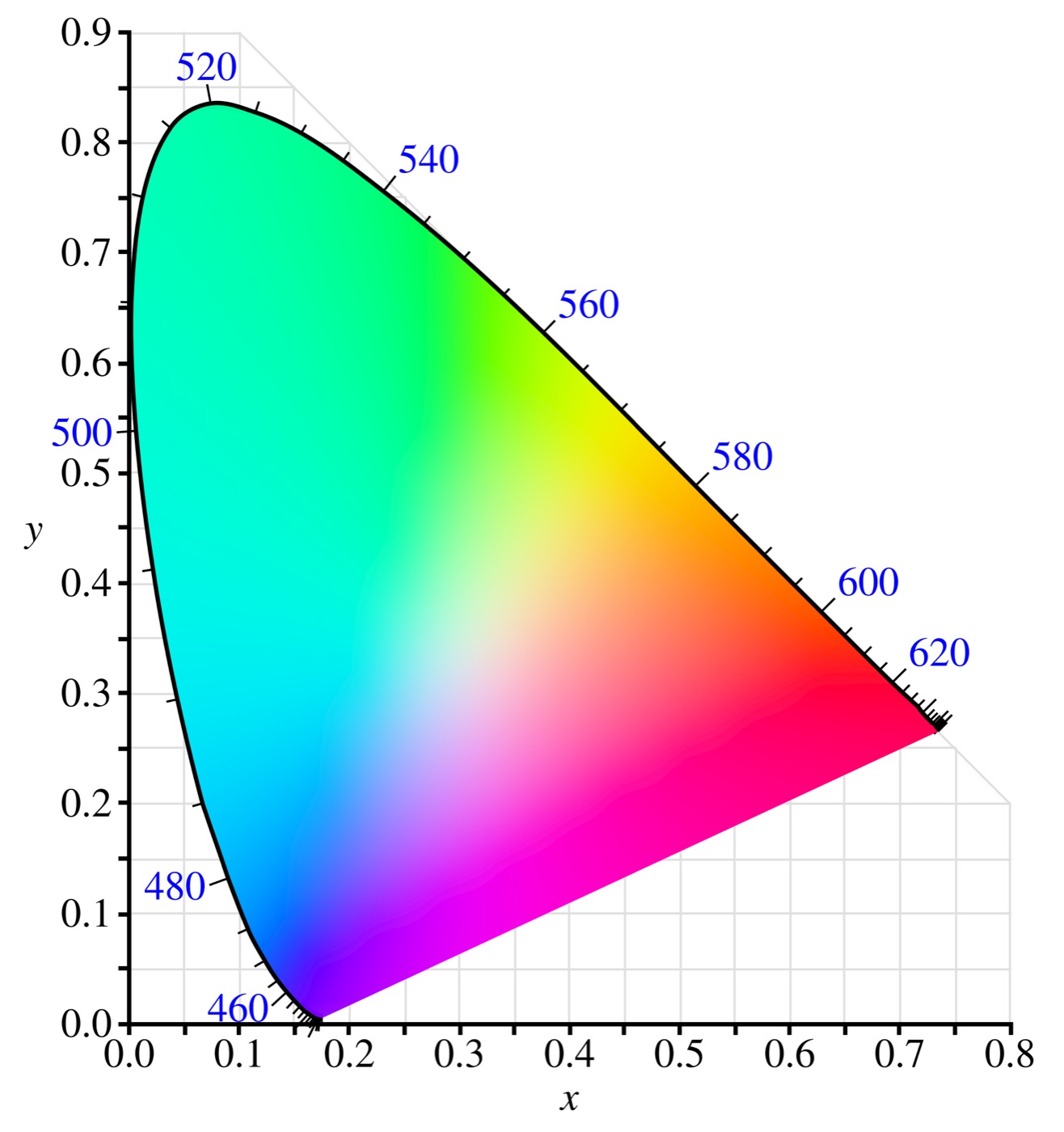
The Commission Internationale de l’Éclairage (CIE), the international commission on illumination, adopted its system of colorimetry at its eighth session, held at Cambridge, England, in 1931. The system rests on color-matching experiments made in the 1920s by W. D. Wright, with ten observers, and J. Guild, with seven. From their results the CIE defined a standard observer, the average color response of the human eye over a field of 2°, and standard illuminants A, B and C.
Any color can then be stated as three numbers, the tristimulus values X, Y and Z, computed from the light reaching the eye. The xy chromaticity diagram above plots color without regard to lightness. A standard observer for a 10° field followed in 1964.
CIELAB
In 1976 the CIE recommended two color spaces in which equal distances correspond more nearly to equal visible differences: CIELUV and CIELAB. CIELAB gives each color a lightness, L*, and two coordinates, a* from green to red and b* from blue to yellow. It is now the joint standard ISO/CIE 11664-4:2019.
Sources and further reading
Written with Claude, an AI model made by Anthropic, from the sources listed above, and checked against them. October 2026.