The five orthodox colors of Chinese tradition, red from cinnabar, and the national color system of the 1990s.
The five colors
Chinese tradition names five orthodox colors (wuse 五色, or zhengse 正色): qing 青, chi 赤, huang 黄, bai 白 and hei 黑. They are tied to the five phases (wuxing) and to the directions: qing to wood and the east, chi to fire and the south, huang to earth and the center, bai to metal and the west, hei to water and the north. Qing covers both the blues and the greens that English separates.
Red from cinnabar
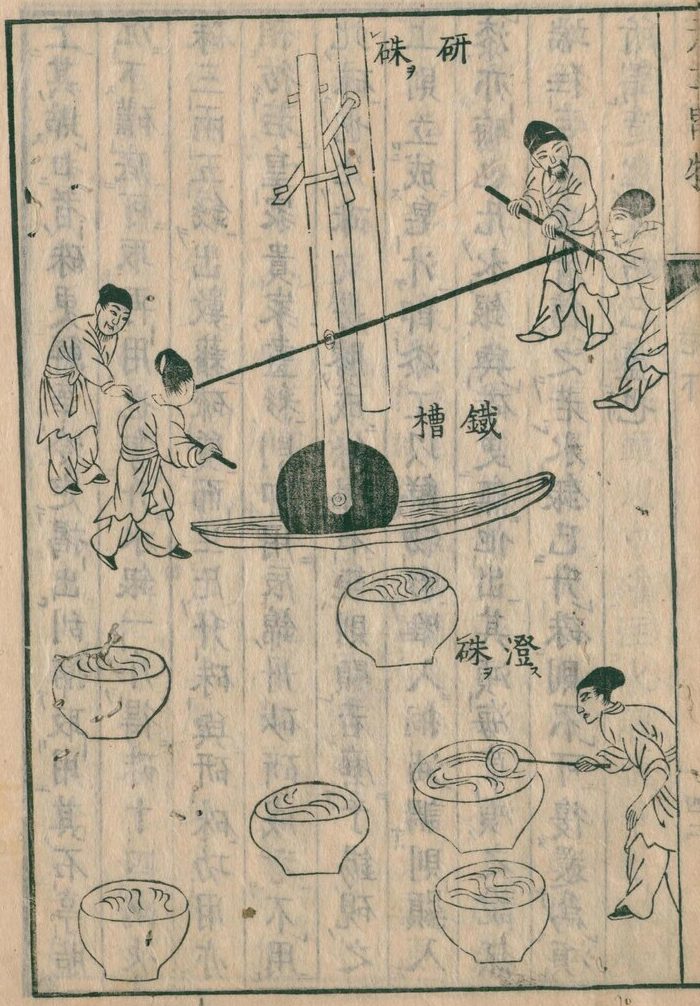
Some Chinese color words began as the names of materials. Dan 丹 is cinnabar, the red sulfide of mercury, and danqing 丹青, red and blue-green, came to mean painting itself. Song Yingxing’s Tiangong kaiwu of 1637, a survey of Chinese crafts, gives a chapter of that name to the making of vermilion and ink; its illustrations show cinnabar being ground to pigment.
The Chinese Color System
At the Institute of Psychology of the Chinese Academy of Sciences, Wang Daheng, Jing Qicheng and their colleagues built a color system from visual experiments with Chinese observers, establishing uniform scales of lightness, hue and chroma, and produced an atlas of samples. Their paper of 1997 records that the work passed review in July 1993 and was accepted as a national standard in June 1994. Standards listings give it as GB/T 15608-1995, The Chinese color system, revised as GB/T 15608-2006, in effect from 1 February 2007.
Sources and further reading
- Color in Chinese culture. Wikipedia
- Song Yingxing, Tiangong kaiwu (first published 1637), Japanese edition of 1771, vol. 8. National Diet Library. Full scan (Commons)
- Wang Daheng, Jing Qicheng, Sun Xiuru, Lin Zhiding and Zhang Jiaying, 1997, 中国颜色体系研究 (The Chinese color system). Acta Psychologica Sinica 29(3): 225–233. Acta Psychologica Sinica
Written with Claude, an AI model made by Anthropic, from the sources listed above, and checked against them. October 2026.