A chemist at the Gobelins tapestry works explains why colors change beside one another, and then maps the colors on a set of circles.
The law of simultaneous contrast
Michel-Eugène Chevreul (1786–1889) was a chemist who directed the dye department of the Gobelins tapestry works in Paris. Weavers complained that some of his dyes looked dull. Chevreul found that the fault lay not in the dyes but in the threads woven beside them: a color seen next to another appears changed by it.
He set this out in De la loi du contraste simultané des couleurs (Paris: Pitois-Levrault, 1839). An English translation credited to Charles Martel, The Principles of Harmony and Contrast of Colours, was published by Longman from 1854.
The chromatic circles
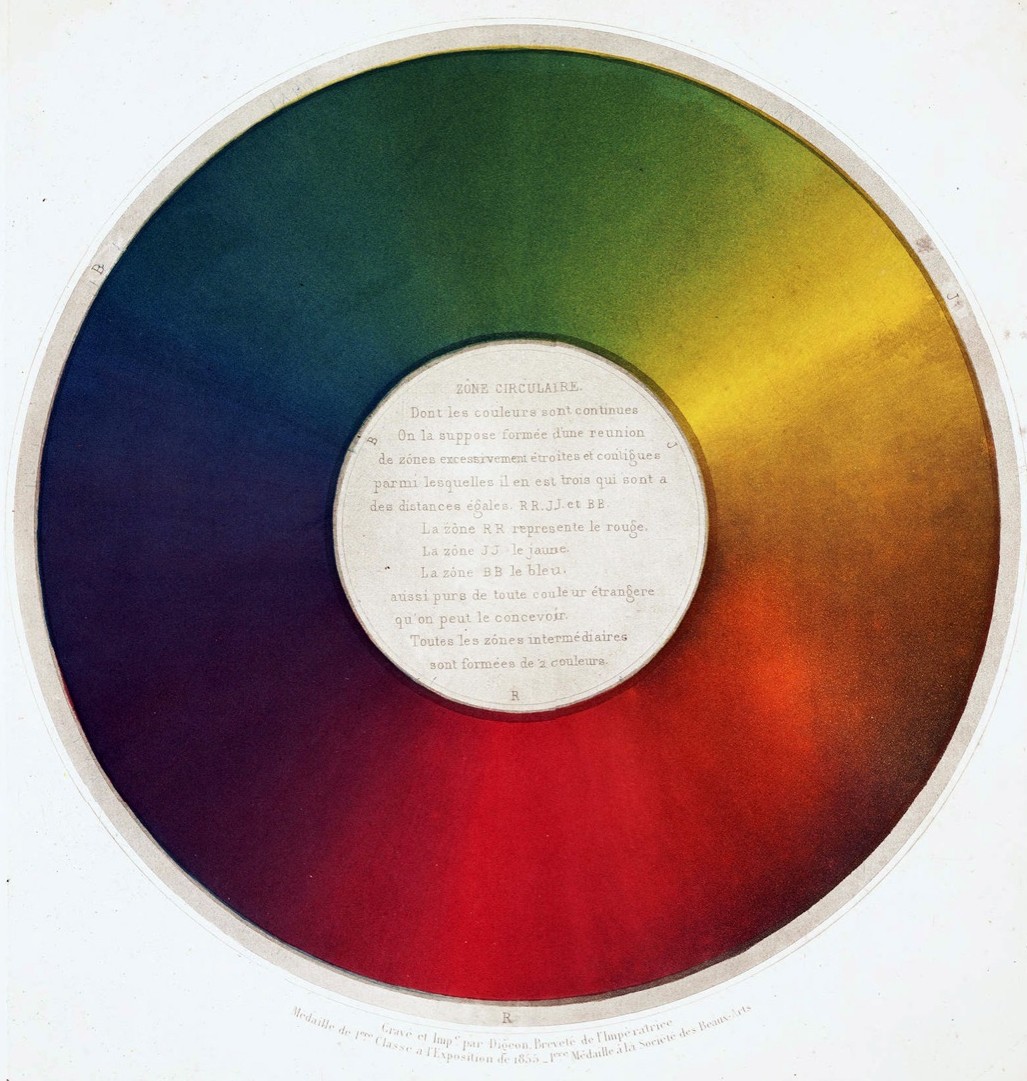
In 1861 Chevreul published the Exposé d’un moyen de définir et de nommer les couleurs, a method for defining and naming colors by their place on a series of circles. The plates were used again in Des couleurs et de leurs applications aux arts industriels à l’aide des cercles chromatiques (Paris: Baillière, 1864).
Sources and further reading
- Cercle chromatique, Chevreul, 1861. Linda Hall Library. Commons
- Chevreul, M.-E., 1839, De la loi du contraste simultané des couleurs. Paris: Pitois-Levrault. Full scan (Internet Archive)
- Chevreul, M.-E., 1855, The principles of harmony and contrast of colours, translated by C. Martel. London: Longman. Full scan (Internet Archive)
- Chevreul, M.-E., 1864, Des couleurs et de leurs applications aux arts industriels à l’aide des cercles chromatiques. Paris: Baillière. Smithsonian Libraries copy. Full scan (Internet Archive)
Written with Claude, an AI model made by Anthropic, from the sources listed above, and checked against them. October 2026.