A working painter’s handbook that names seven natural colors and tells where each pigment is dug or how it is made, including the recipe for ultramarine from lapis lazuli.
A painter’s handbook
Cennino d’Andrea Cennini, of Colle di Val d’Elsa in Tuscany, says at the opening of his book that he was trained for twelve years by Agnolo, son of Taddeo Gaddi, who had been Giotto’s pupil. Documents of 1398 show him living in Padua in the household of Francesco da Carrara. Il libro dell’arte is usually dated about 1400 and may have been written in Padua. One manuscript ends with the date 31 July 1437 and the words “ex Stincarum,” from the Stinche, the debtors’ prison of Florence. This was long taken to mean that Cennini wrote the book there, but his name has not been found in the prison records, and the note may be a copyist’s.
The book is practical throughout: how to grind colors, prepare panels and walls, gild, and paint in fresco and in tempera. There are two public-domain English translations, Mary Merrifield’s of 1844 and Christiana Herringham’s of 1899, which is quoted here. Daniel V. Thompson’s translation, The Craftsman’s Handbook (1933), is cited but not quoted.
Seven natural colors
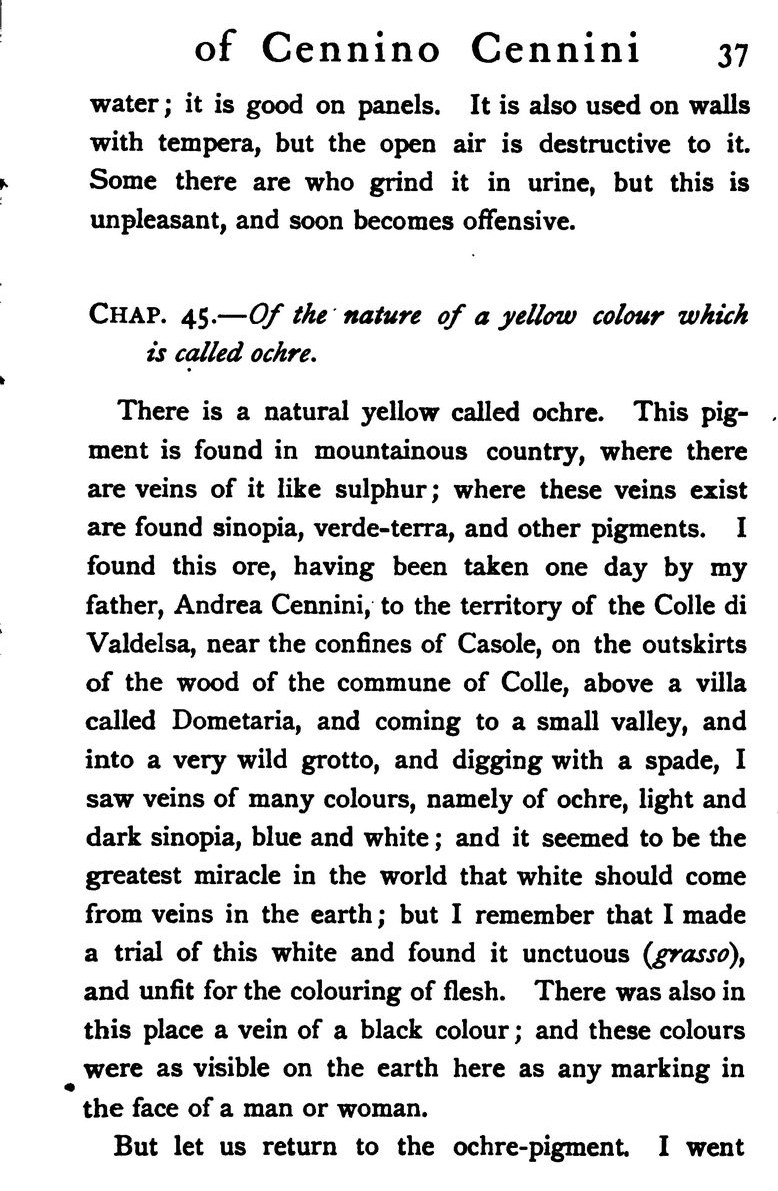
Cennini’s classification is a painter’s, made by the source and handling of the pigment. Chapter 36 begins: “You must know that there are seven natural colours; namely, four which are of the nature of earths, as black, red, yellow, and green; three are natural colours, but require the assistance of art, as white, ultramarine blue, or della magna blue, and giallorino.” He then takes the colors one by one: blacks, reds, yellows, greens, whites and blues.
The earths come out of the ground. Ochre, he writes, is found in mountainous country in veins like sulphur, with sinopia and green earth nearby. Taken one day by his father Andrea into the woods of Colle above a place called Dometaria, he dug in a grotto and “saw veins of many colours, namely of ochre, light and dark sinopia, blue and white; and it seemed to be the greatest miracle in the world that white should come from veins in the earth.” The colors, he says, showed on the earth there “as any marking in the face of a man or woman.”
Cinnabar, azurite and the rest
Cennini knew vermilion as a made pigment. In chapter 40 he says that cinnabar “is made by a chemical process performed in an alembic,” and leaves the recipes to the monks. The painter should buy it from the apothecary, always as a whole unbroken lump, because ground cinnabar is often adulterated with red lead and brick dust. It lasts better on panels than on walls, where exposure to the air turns it black.
Azzurro della Magna, “German blue” (chapter 60), is “a natural pigment of a blue colour, which is found in and around veins of silver,” produced in quantity in Germany and near Siena. It is the copper carbonate now called azurite. Among the other colors he treats are lead white (biacca), the lime white called bianco sangiovanni, verdigris, green earth, orpiment, and giallorino, which he describes as an artificial yellow.
Ultramarine from lapis lazuli
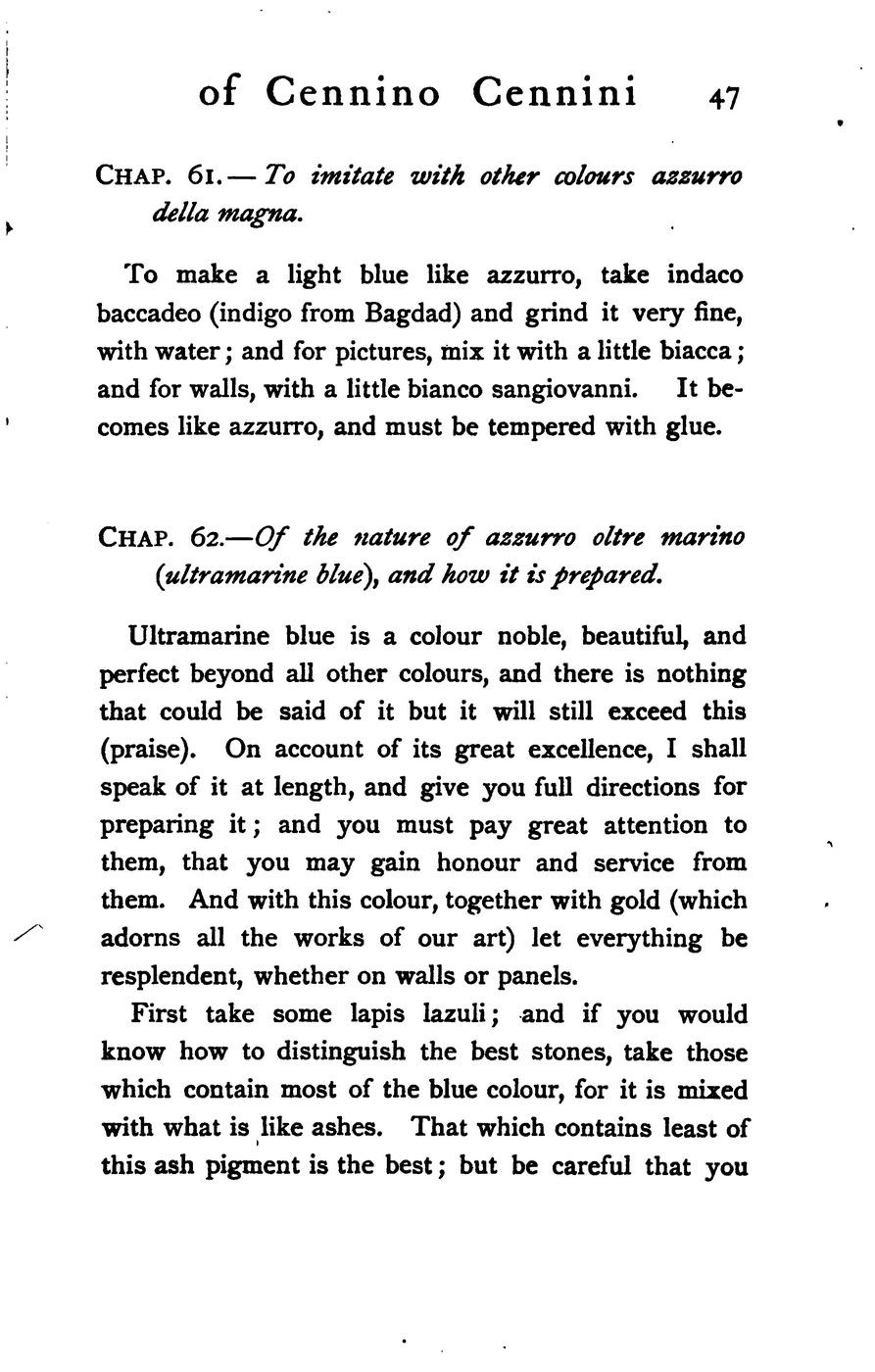
The longest of Cennini’s pigment chapters is chapter 62, on ultramarine, “a colour noble, beautiful, and perfect beyond all other colours.” The painter is to choose the lapis lazuli that contains the most blue, “for it is mixed with what is like ashes,” and not to mistake azurite for it. The stone is pounded in a covered bronze mortar, ground dry on porphyry and sifted. The powder is worked into a paste with melted pine resin, mastic and new wax and kneaded for at least three days and nights. The paste is then kneaded with two sticks in warm lye, which takes up the blue; the blue lye is poured off and fresh lye added, day after day, until the paste no longer colors it.
The blue settles in the basins in order of quality. The first extracts are the best: from good stone, Cennini says, the azure of the first two is worth eight ducats the ounce, while “the last two extracts are worse than ashes.” The process separates the blue mineral lazurite from the calcite and other minerals of the rock. It is the clearest example in these texts of a mineral’s quality judged by eye before it is worked.
Sources and further reading
- Cennini, C., A Treatise on Painting, translated by Mary P. Merrifield, with notes by Giuseppe Tambroni. London, 1844. Full scan (Internet Archive)
- Cennini, C., The Book of the Art of Cennino Cennini, translated by Christiana J. Herringham. London: George Allen, 1899. Full scan (Internet Archive)
- Cennini, C., The Craftsman’s Handbook “Il Libro dell’Arte,” translated by Daniel V. Thompson Jr. New Haven: Yale University Press, 1933. Cited, not quoted.
Written with Claude, an AI model made by Anthropic, from the sources listed above, and checked against them. October 2026.