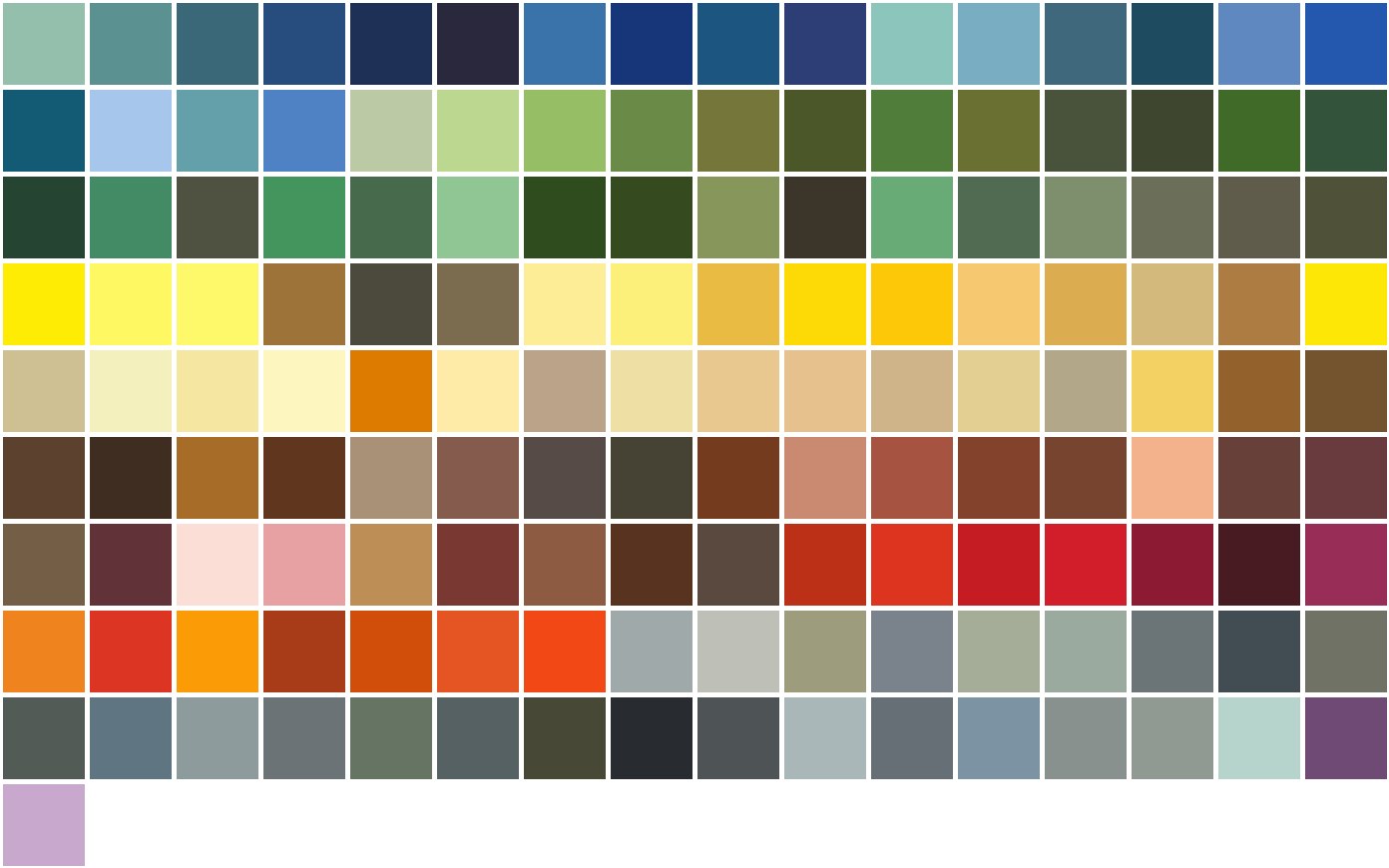
The British Standards Institution’s numbered colors for identification, coding and special purposes.
A British standard for colors
The BS 381C colors, current and withdrawn, as approximate screen values. Chart made for this page from the non-official values published by W3Schools; the standard itself defines the colors by physical samples.
BS 381C is the British standard that names and illustrates colors “for identification, coding and special purposes.” Its origins are usually placed in 1930: an architects’ memorandum of 1980 from the paint maker Resene says that the development of a range of standard colors “goes back to 1930, when the British Standards Institution realised there was a need for standardised colours.” The standards body’s own record of a first edition has not been found, and the date is given here as reported.
An edition of 1964 bore the title “Colours for ready mixed paints.” The 1980 edition, under the present title, was published on 30 September 1980 and withdrawn in 1988. The current edition, BS 381C:1996, specifies 91 colors.
Numbers and names
Each color has a three-digit number and a name. The British Post Office, for example, used paint to BS 381C on its equipment and vehicles: 538 Post Office Red on mail vans until about 1968, and 631 Light Grey and later 384 Light Straw on equipment racks.
The standard itself is in copyright, and its printed color cards are not reproduced here. The chart above and the table below are screen approximations instead.
The colors
The table gives each color’s number and name, with approximate screen values published by W3Schools, which describes them as “non official approximate values.” It includes colors withdrawn from earlier editions as well as the 91 of the current one. Several of the names come from minerals and pigments, among them turquoise blue, cobalt blue, ruby, Portland stone and red oxide, the color of iron-oxide primer.