The first systematic account of color in Greek philosophy, in which colors are mixtures of white and black and the rainbow has three colors.
Color as the limit of the transparent
Aristotle (384–322 BCE) treats color in the short work On Sense and the Sensible (De sensu et sensibilibus), one of the natural treatises later grouped as the Parva naturalia, and again, for the colors of the rainbow, in the third book of the Meteorologica. Neither work can be dated precisely. Both belong to the middle or later decades of the fourth century BCE, and the year given here is an approximation only.
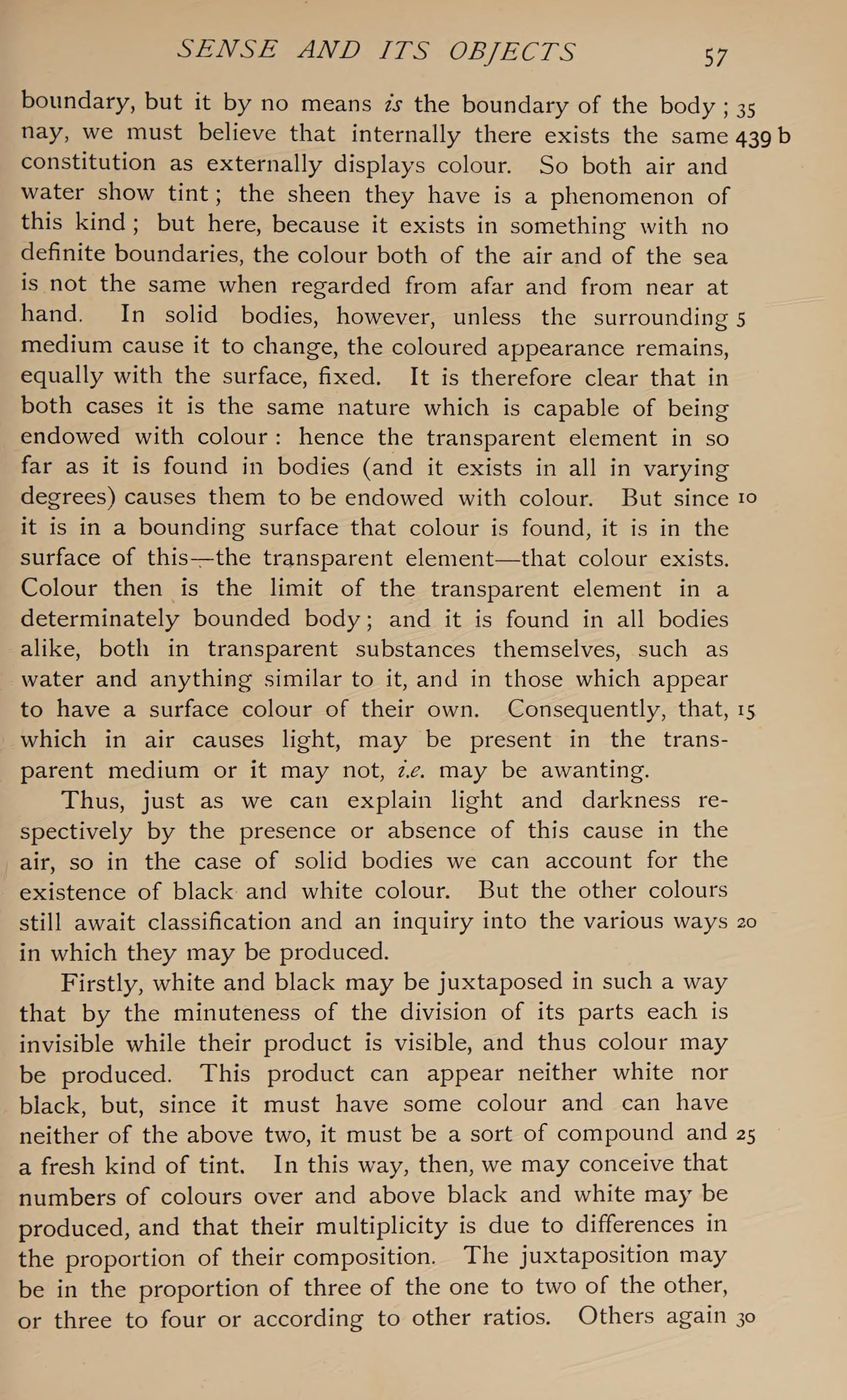
In chapter 3 of De sensu color belongs to the transparent, the nature that air and water share with solid bodies. Light is the actual state of the transparent; in a body, color is its surface. In G. R. T. Ross’s translation of 1906, “Colour then is the limit of the transparent element in a determinately bounded body.” The presence or absence in bodies of what makes light in air accounts for white and black. The other colors remain to be explained.
Mixtures of white and black
Aristotle considers three ways in which the other colors could arise from white and black. They might be laid side by side in particles too small to be seen, so that the eye receives one new color. They might show through one another, as when painters lay a wash of color over a brighter one, or as the sun, white in itself, looks red through mist and smoke. Or they might be truly mixed. He finds difficulty with the first, which seems to require invisible magnitudes, and concludes that when substances are mixed their colors are mixed too, and that this is the chief reason why there are many colors.
The proportion of white to black decides the color. Colors made in simple numerical ratios, like the ratios of musical concords, are the most pleasant; Ross’s page 59 gives purple and crimson as examples. Mixtures in no calculable ratio give the rest.
In chapter 4 Aristotle sets colors beside flavors and counts seven of each. In Ross’s translation: “If, as is reasonable, one reckons grey to be a kind of black, there are seven of each, for there remain yellow — to be referred to white, as oily was to sweet — with crimson, purple, green, and blue intermediate between black and white; and all other colours are got by combining these.” The result is an ordered series from white to black. Ross notes that some editors would read “six” for “seven” in this passage.
The colors of the rainbow
The Meteorologica explains the rainbow as a reflection of sight from the small drops of a cloud toward the sun. In E. W. Webster’s translation, each rainbow “is three-coloured; the colours are the same in both and their number is the same, but in the outer rainbow they are fainter and their position is reversed.” The three are red, green and purple: “These are almost the only colours which painters cannot manufacture: for there are colours which they create by mixing, but no mixing will give red, green, or purple.” An orange band is often seen between the red and the green.
Aristotle explains the yellow of the rainbow in III.4 as an effect of contrast: the red looks whiter beside the green and against the dark cloud. In the same place he notes that dyed and embroidered stuffs change in appearance with the colors set beside them and with the light, so that embroiderers working by lamplight often choose the wrong colors.
Neither account has mineral content beyond the painters’ colors Aristotle mentions in passing. Its importance is as the starting point of the long tradition that ordered colors between white and black.
Sources and further reading
- Aristotle, De sensu and De memoria. Text and translation with introduction and commentary by G. R. T. Ross. Cambridge: Cambridge University Press, 1906. Full scan (Internet Archive)
- Aristotle, Meteorologica, translated by E. W. Webster (Oxford, 1923), in The Works of Aristotle translated into English, vol. III, ed. W. D. Ross. Oxford: Clarendon Press, 1931. Full scan (Internet Archive)
Written with Claude, an AI model made by Anthropic, from the sources listed above, and checked against them. October 2026.