The manganese-black and ochre-red mummies of the Chinchorro of northern Chile, and the cinnabar of Huancavelica, mined for vermilion for some three thousand years before the Spanish conquest.
The Chinchorro: black mummies and red mummies
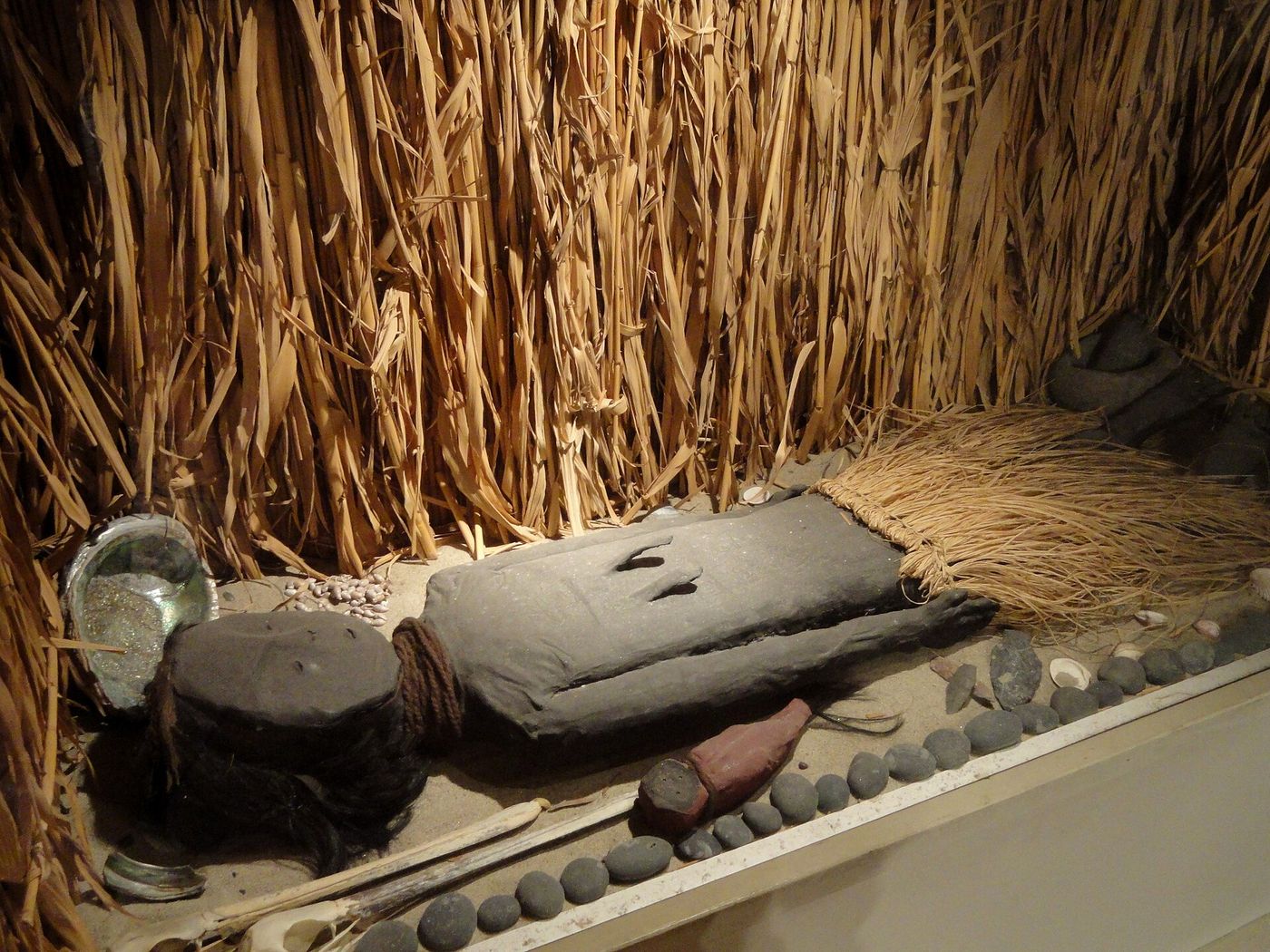
The oldest known artificial mummies were made by the Chinchorro, maritime hunters, gatherers and fishers of the coast of the Atacama Desert in northern Chile. Bernardo Arriaza and his colleagues (2023) write that about 6,000 years ago the Chinchorro began mining manganese to ornament the dead, the earliest form of artificial mummification in the world. The Arica–Camarones area, at the northern tip of Chile, was the center of the practice.
Two colors mark its two main periods. In the period of the so-called black mummies, about 6000 to 4750 years before present, the body was completely covered with a few millimeters of manganese dioxide paint, except for the hair. In the following period, about 4750 to 3950 years before present, the “red mummies” were painted with red ochre, the iron oxide hematite, Fe2O3, and a thick manganese-based paste was applied only to the face and scalp, to hold a long black wig in place. The face was rebuilt as a black or reddish mask.
The blacks have been identified mineral by mineral. Pyrolusite, MnO2, is one of the compounds found in the coating of the mummies (Sepúlveda 2014, 2015). X-ray fluorescence and Raman spectroscopy of twelve artifacts from Chinchorro funerary contexts at Arica found manganese in all of them, and identified the analyzed pigment as cryptomelane and goethite (Latin American Antiquity, 2024). Arriaza and his colleagues note that among the Chinchorro cryptomelane appears to be the more common. The paint on the black mummies contains 24.0 to 35.1 percent manganese by weight; the black caps of the red mummies contain 46.0 to 60.7 percent.
The manganese was gathered nearby. Arriaza and his colleagues found strata and pockets of manganese ore among the cobbles of the Lluta River, at its mouth on the coast and about 8 km inland, with up to 62.4 and 66.1 percent manganese. The work was not without cost. In the ribs of 68 Chinchorro individuals they found manganese above the normal level of 1 part per million in 57, and at levels of higher toxicity in 14, with no difference between men and women, and they conclude that the mining and refining of manganese for the treatment of the dead posed a serious occupational hazard for the living.
Cinnabar and vermilion: Huancavelica
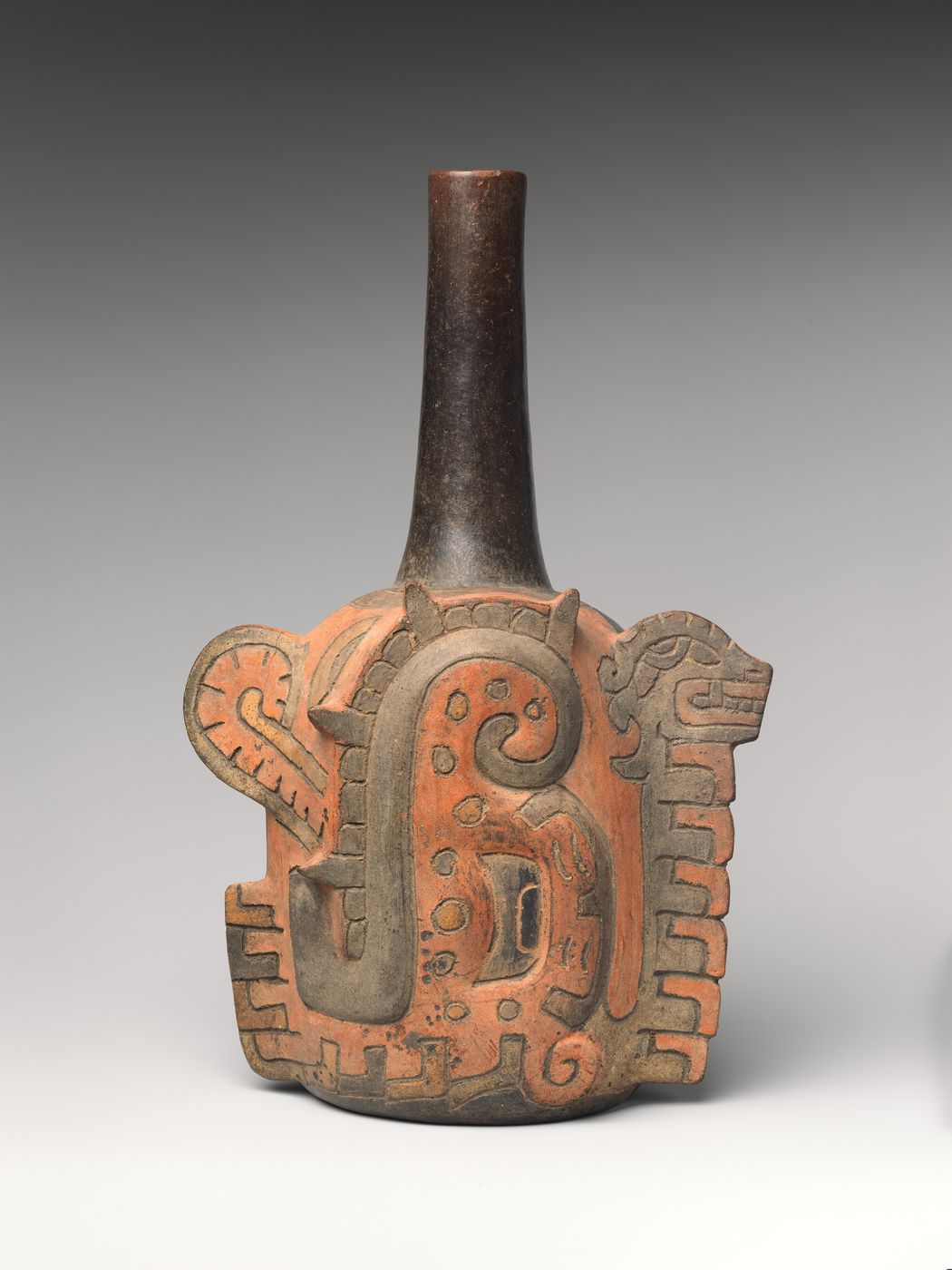
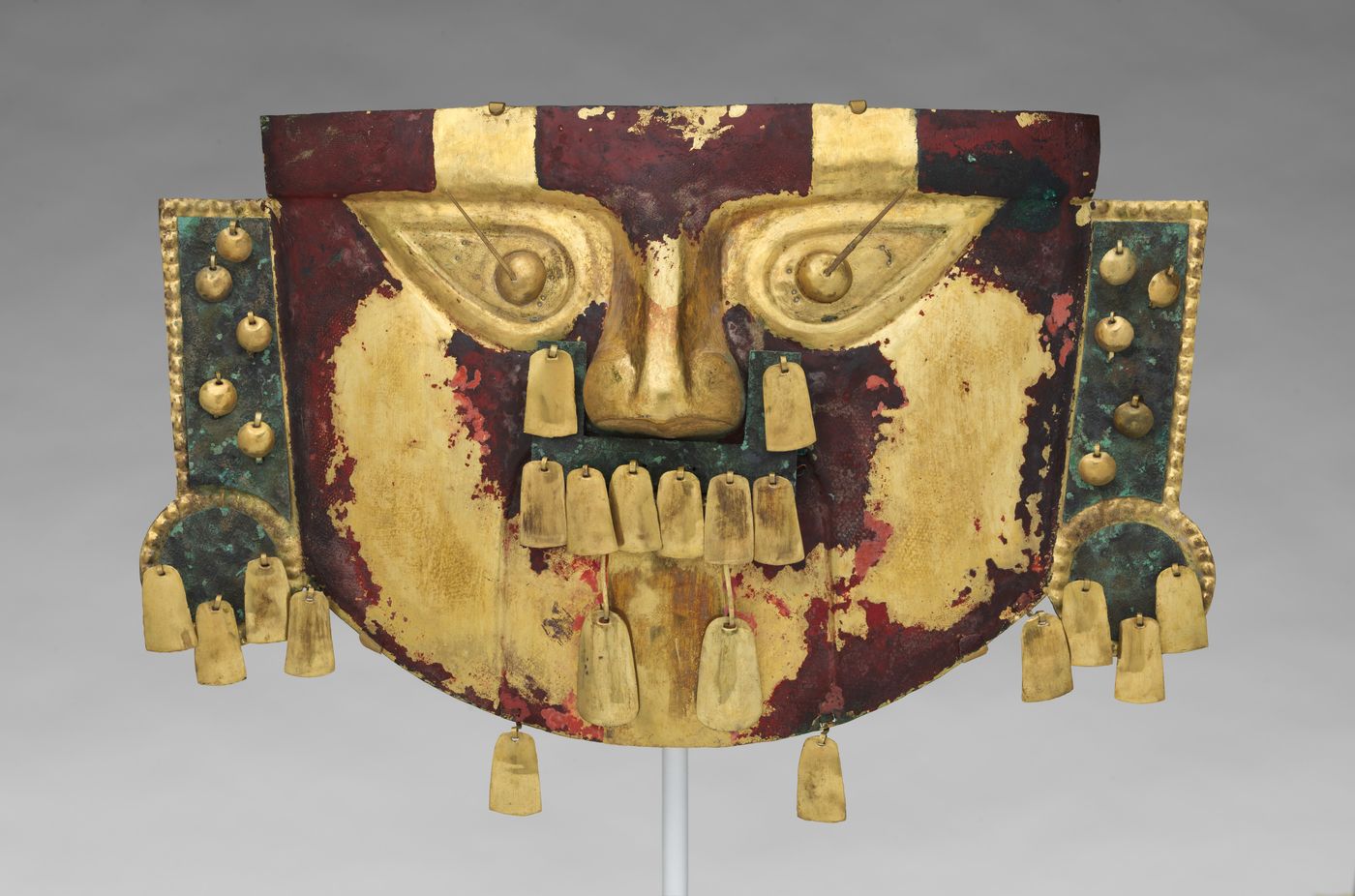
Cinnabar, mercury sulfide, HgS, is the principal ore of mercury, and when powdered it gives the bright red pigment vermilion. In the Andes, as Colin Cooke and his colleagues (2009) write, the use of vermilion was closely tied to that of precious metals: it has been recovered in elite burials from the first Andean empire, the Chavín, to the last, the Inca, where it was used as body paint or as a covering on ceremonial objects of gold.
The largest mercury deposit in the New World lies at Huancavelica, on the eastern slope of the Cordillera Occidental in central Peru. Cinnabar is the dominant ore there, and more than 90 percent of the documented production came from the Santa Bárbara mine, immediately south of the town. Cooke and his colleagues measured mercury in sediment cores from two small lakes near Huancavelica, both called Laguna Yanacocha, and from a third lake, Laguna Negrilla, about 225 km away. Mercury accumulation in the two nearby lakes began to rise sharply about 1400 BCE, before the emergence of complex Andean societies, and by 600 BCE it stood about ten times above the natural background. The earliest mining, they conclude, targeted cinnabar for the production of vermilion, and what fell into the lakes at first was mostly cinnabar dust.
The record has two pre-Hispanic peaks, about 500 BCE and about 1450 CE, which the authors match with the heights of the Chavín and the Inca. After the Inca conquest of the region, about 1450, smelting was adopted at the mine, the pollution spread more widely, and mercury began to reach the distant Laguna Negrilla. In the colonial period Huancavelica became the largest single supplier of mercury to the silver mines of Spanish America, where mercury amalgamation, introduced in 1554, was used to extract silver from low-grade ores; cave-ins and mercury poisoning earned the mine the name mina de la muerte, the mine of death.
The date on the timeline
On the timeline of color systems this page is placed at 4000 BCE, a round figure for the beginning of the black mummies of the Chinchorro, which Arriaza and his colleagues date to about 6000 years before present. The cinnabar mining at Huancavelica began later, about 1400 BCE, and continued under the Inca and into the colonial period.
Local minerals: Franklin and Sterling Hill
The Andean colors described here are oxides of iron and manganese and a sulfide of mercury. The oxides are, in small measure, minerals of the two New Jersey zinc mines this site describes; the sulfide is not. The record used here is Charles Palache’s The Minerals of Franklin and Sterling Hill (U.S. Geological Survey Professional Paper 180, 1935), with the list of mineral species found at Franklin and Sterling Hill revised by the Mineral List Committee in August 2017, which counts 367 species and marks each F for Franklin or O for Ogdensburg, the town of the Sterling Hill mine.
Hematite (local mineral; Franklin Mine and Sterling Mine on mindat.org), the red of the Chinchorro red mummies. Palache describes coarse granular masses of hematite at Franklin (pp. 41–42) and writes that, as the coloring matter of jasper and as an alteration product of franklinite, hematite is widespread at both Franklin and Sterling Hill but not a conspicuous mineral at either. The 2017 list gives hematite F, O.
Goethite and cryptomelane (local minerals; Franklin Mine and Sterling Mine on mindat.org), the two minerals identified in the Chinchorro pigment from Arica. Palache records goethite only sparingly, as minute dark-brown needles on tiny globules of hematite in the dolomite of the Buckwheat mine at Franklin (p. 49); the 2017 list gives goethite F, O. Cryptomelane, a potassium manganese oxide, is not in Palache’s book; the 2017 list records cryptomelane at Sterling Hill (O). Palache does record other black manganese oxides there, among them compact, coal-black masses on the dump of the Noble mine that appear to be psilomelane (p. 53). Psilomelane was then the usual name for hard black manganese oxides; it is no longer a species, and most such material is now identified as romanèchite or other manganese oxides.
Pyrolusite, the other manganese mineral reported from the Chinchorro coatings, is not among the species Palache recorded from the district, nor on the 2017 list. Cinnabar is not a mineral of Franklin or Sterling Hill. And the Chinchorro and the miners of Huancavelica had nothing to do with New Jersey. The connection is one of chemistry: the black and the red of the Chinchorro dead are oxides of manganese and iron, and so is much of the ore at Franklin and Sterling Hill.
Sources and further reading
- Arriaza, B., Figueroa, L., Ogalde, J. P., Standen, V., Halcrow, S., Amarasiriwardena, D., Van Hoesen, J., Castelleti, J., 2023, An archaeometric approach to biocontamination with manganese pigments in ancient marine hunter-gatherers of the Atacama Desert: health, ideological, and socioeconomic considerations. Archaeological and Anthropological Sciences 15, 188. Open access (CC BY 4.0). PDF
- Bottle with caiman, Cupisnique, 1000–800 BCE. Metropolitan Museum of Art, 1978.412.203. Public domain. The Met
- Chinchorro mummy, San Diego Museum of Man, photograph by Daderot, 2013. CC0. Wikimedia Commons
- Cooke, C. A., Balcom, P. H., Biester, H., Wolfe, A. P., 2009, Over three millennia of mercury pollution in the Peruvian Andes. Proceedings of the National Academy of Sciences 106, 8830–8834. Full text (PMC)
- Evidencia arqueométrica del uso del manganeso en artefactos asociados a la cultura Chinchorro (Archaeometric evidence of the use of manganese in artifacts associated with the Chinchorro culture). Latin American Antiquity 35 (2024), 246–253. Publisher
- Funerary mask, Lambayeque (Sicán), 900–1100 CE. Metropolitan Museum of Art, 1974.271.35. Public domain. The Met
- Mineral species found at Franklin-Sterling Hill, NJ, revised by the Mineral List Committee, August 2017. In: Franklin-Ogdensburg Mineralogical Society, 2017 Mineral Show booklet, pp. 3–5. PDF
- Palache, C., 1935, The minerals of Franklin and Sterling Hill, Sussex County, New Jersey. U.S. Geological Survey Professional Paper 180. Hematite, pp. 41–42; goethite, p. 49; psilomelane, p. 53. PDF
Written with Claude, an AI model made by Anthropic, from the sources listed above, and checked against them. October 2026.