The first Renaissance treatise on painting, which names four true colors after the four elements and treats white and black as the means of changing them.
On Painting
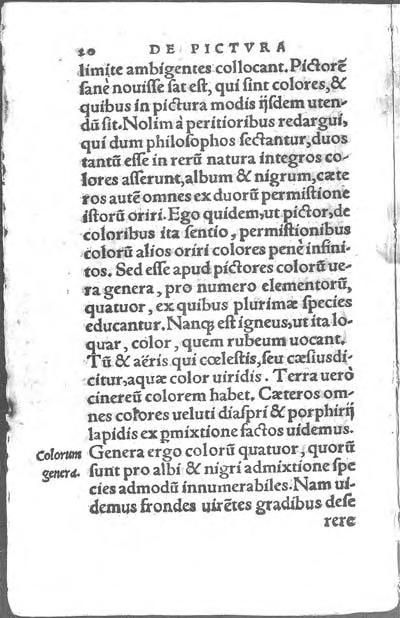
Leon Battista Alberti (1404–1472), humanist and architect, wrote De pictura (On Painting) in Latin in 1435, and an Italian version, Della pittura, which he dedicated to Filippo Brunelleschi in 1436. The first of its three books sets out the geometry of perspective, the second composition, and the third the training of the painter. The Latin text was first printed at Basel in 1540. The English quoted here is James Leoni’s, made from Cosimo Bartoli’s Italian and printed with Alberti’s Architecture; the scan is of the edition of 1755.
Four true colors
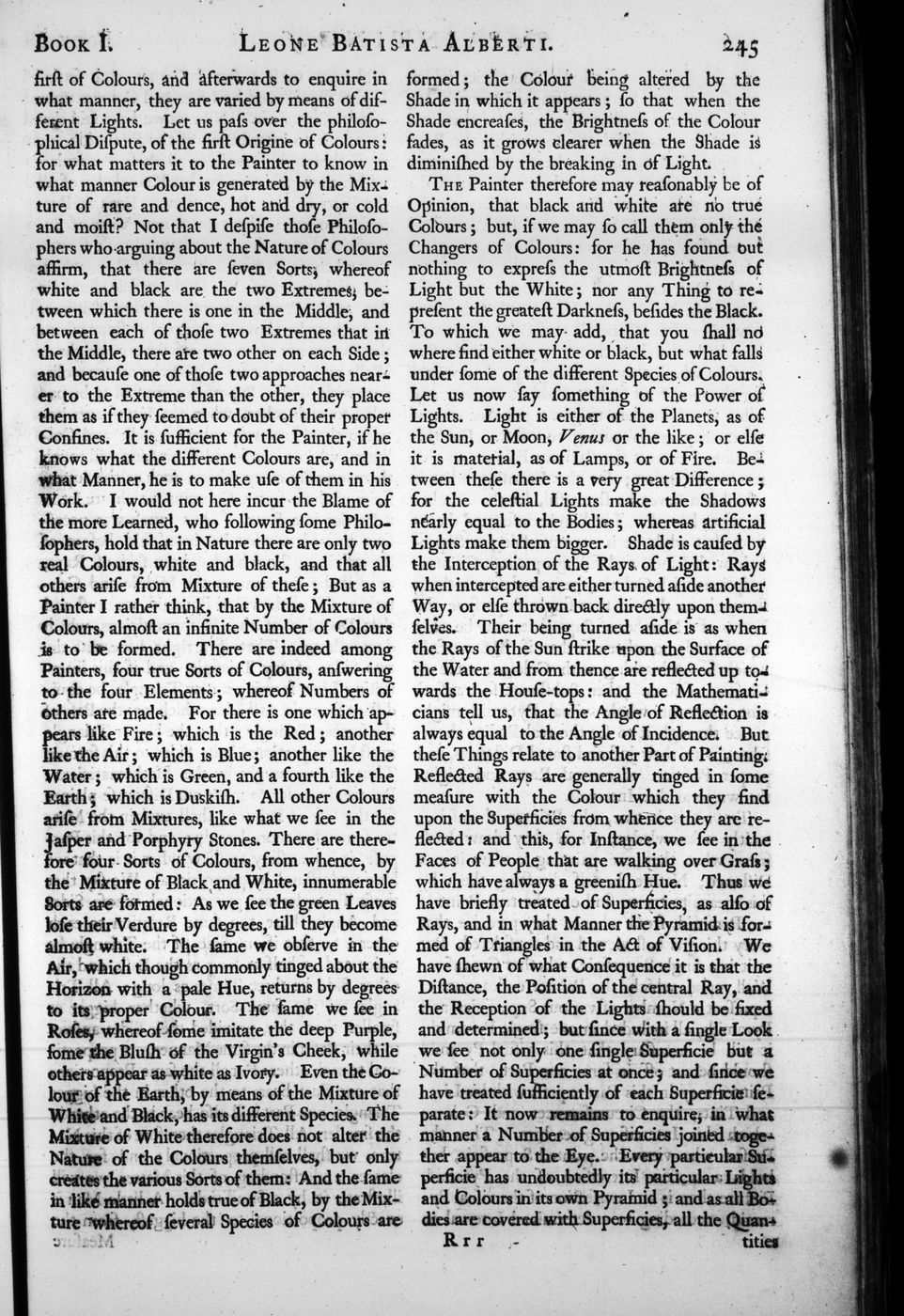
Alberti begins his remarks on color by setting the philosophers aside. He mentions those who count seven species of color, with white and black at the extremes, one in the middle and two between each extreme and the middle, and those who hold that there are only two true colors, white and black, from which all others are mixed. For the painter, he says, it is enough to know what the colors are and how to use them.
He then gives his own scheme. In Leoni’s translation: “There are indeed among Painters, four true Sorts of Colours, answering to the four Elements; whereof Numbers of others are made. For there is one which appears like Fire; which is the Red; another like the Air; which is Blue; another like the Water; which is Green, and a fourth like the Earth; which is Duskish.” Where Leoni has “duskish,” the Latin of 1540 has cinereus, ash-colored: Terra vero cinereum colorem habet. All other colors, Alberti continues, arise from mixtures, “like what we see in the Jasper and Porphyry Stones.”
White and black
From each of the four sorts, Alberti says, innumerable species are made by mixing in white and black. Green leaves lose their green by degrees until they are almost white; the air, pale near the horizon, returns by degrees to its own color; some roses are deep purple and others white as ivory; even the color of earth has its species. In Leoni’s words, “The Mixture of White therefore does not alter the Nature of the Colours themselves, but only creates the various Sorts of them,” and the same holds of black.
He therefore holds that “black and white are no true Colours; but, if we may so call them only the Changers of Colours.” The painter has nothing but white to express the greatest brightness of light, and nothing but black for the deepest darkness. White and black stand outside the four colors as the means of lightening and darkening them.
The scheme classifies appearances, not pigments; Alberti does not name the materials. His one mineral reference is to the mottled colors of jasper and porphyry, the ornamental stones of Italian building, as an image of what mixture produces.
Sources and further reading
- Alberti, L. B., 1540, De pictura praestantissima, et nunquam satis laudata arte libri tres absolutissimi. Basel. Full scan (Internet Archive)
- Alberti, L. B., 1755, The Architecture of Leon Batista Alberti in ten books. Of Painting, in three books. And of Statuary, in one book. Translated into Italian by Cosimo Bartoli, and into English by James Leoni. London. Full scan (Internet Archive)
Written with Claude, an AI model made by Anthropic, from the sources listed above, and checked against them. October 2026.